Mobile Apps
Loyalty and Order-Ahead Apps Customers Keep on Their Phones
Most loyalty apps are installed for one free drink and deleted a month later. The ones that survive save customers time every week, reward them reliably and rarely interrupt. Here is how we design order-ahead, stamps, payments and push offers so the app earns its place on the home screen.
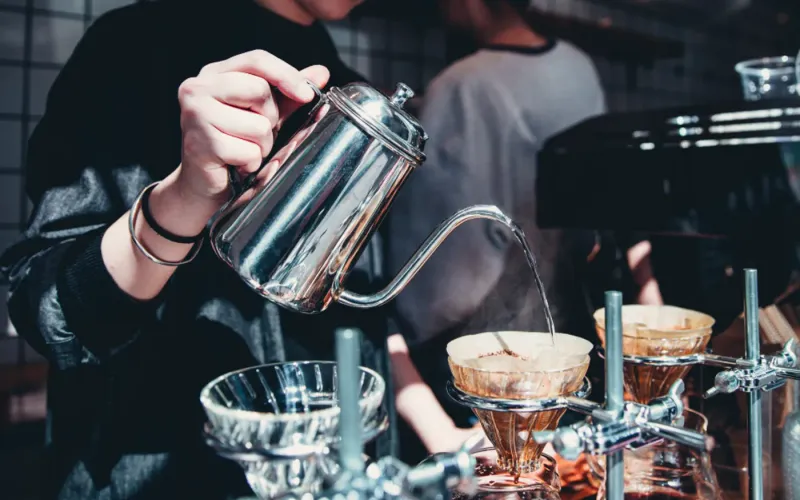
A loyalty app has a harder job than most apps. It competes for space on a phone with banking, messaging and maps, and it is only opened for a few seconds at a time. If those seconds are not useful, the app is deleted the first time the phone runs short of storage. The free drink that persuaded someone to install it is not enough to keep it there.
The apps that last do three things well: they save the customer time every week, they reward them without any doubt about whether a stamp was counted, and they interrupt rarely enough that notifications still get read. This is how we approach each of those as part of our mobile app development work, and the questions worth settling before anyone draws a screen.
Start With the Job the App Does Every Morning
Loyalty alone is a weak reason to open an app. Ordering ahead is a strong one. For a regular who buys the same drink at the same store on the way to work, the app that lets them skip the queue becomes part of the routine, and the stamps come along for the ride.
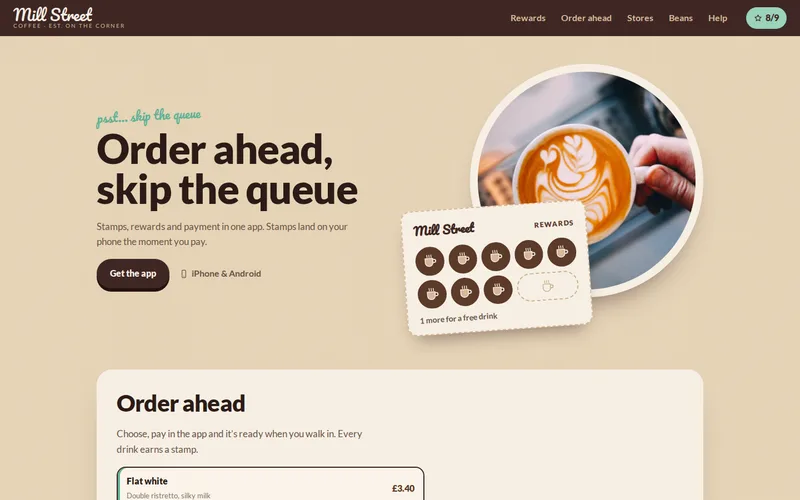
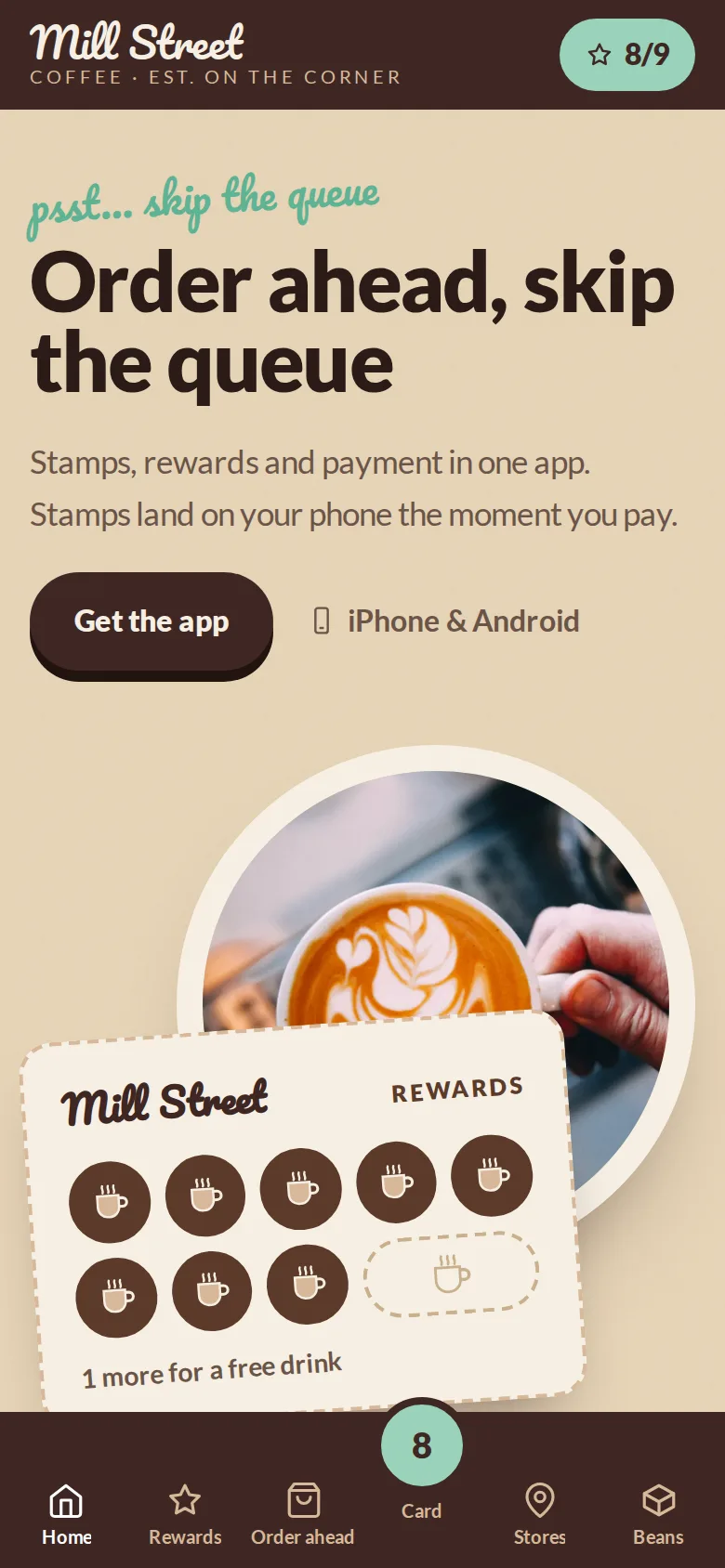
That was the thinking behind the loyalty and order-ahead app we built for a 34-store coffee chain. Customers choose a store, pick a collection time, customise the drink and pay. A favourite order can be repeated in two taps, and a notification says when it is ready. Morning queues had been the main reason regulars walked past, and order-ahead removed that reason.
When you plan your own version, design the repeat journey first:
- Open to paid in under ten seconds for a saved favourite. Every extra screen is a reason to queue instead.
- Store chosen automatically from the last order, with an easy change, because most regulars use one or two locations.
- Collection times the store can actually meet, based on its current order load rather than a fixed five minutes.
- A clear plan for problems: an item that has sold out, a store that closes early, a refund that needs to happen without a phone call.
Loyalty Has to Be Earned at the Till, Not in the App
The most important technical decision in a loyalty app is where rewards come from. If the app decides when a stamp is earned, someone will find a way to earn stamps without buying anything. If staff have to remember to scan a code, they will forget during the rush, and customers will notice.
In the coffee chain project, stamps are awarded server-side through the point-of-sale integration whenever a qualifying purchase goes through the till. A screenshot cannot create a stamp, a lost phone does not lose a card, and nobody behind the counter has to do anything extra. The POS integration is usually the biggest single piece of work in an app like this, so it is worth asking your till provider early:
- Does the POS expose an API or webhooks for completed sales, and how quickly do they arrive?
- Can a customer be identified at the till, by a code in the app or a linked card?
- Can order-ahead tickets be pushed into the store's system with a collection time?
- How are refunds and voids reported, so a refunded purchase removes its stamp?
Our API and integration service covers this layer: the server that sits between the till, the offers engine and the app, and makes sure each purchase is counted once.
Payments and the In-App Wallet
Paying should take one tap. Apple Pay and Google Pay do most of the work here, with saved cards held by the payment provider rather than by you. The coffee chain app supports all three. Card details never touch the chain's own servers, which keeps the security and compliance burden small.
Some businesses also want a stored balance, where customers top up and spend from the app. It can lower card fees on small transactions, but it brings accounting questions about unspent balances and, depending on the country and how the balance works, may raise regulatory ones too. Take advice before building it. For most chains, saved cards and wallet payments give the same speed without those complications. Our payment gateway integration work starts with exactly this choice.
Push Notifications People Do Not Switch Off
Every broadcast offer teaches some customers to ignore the app, and some to turn notifications off for good. Once switched off, they rarely come back on. Treat notification permission as something you can spend, not something you own.
- Separate service messages from marketing. "Your order is ready" is welcome every time. A discount on pastries is not.
- Segment by store, frequency and preference. The coffee chain's offers go out through Firebase Cloud Messaging, but never to everyone by default. An oat-milk drinker at one store hears about the offer that suits them.
- Cap frequency per customer, regardless of how many campaigns marketing wants to run that week.
- Ask for permission at a sensible moment, such as after the first order, when "tell me when it is ready" has an obvious benefit.
- Close the loop. Because redemptions come back through the till, each offer can be measured per store and per segment.
Retention: What to Measure
Downloads are the least useful number a loyalty app produces. These tell you whether it is working:
- Repeat order rate: the share of customers who order ahead again within a set period after their first order.
- Active customers per store: customers who used the app in the last 30 days, store by store.
- Notification opt-out rate: if it climbs after a campaign, that campaign cost you more than it earned.
- Offer redemption by segment: taken from till data, not from app opens.
- Order-ahead share at peak: how much of the busiest hour now arrives through the app.
As a hypothetical example, an offer that 4% of a targeted segment redeems may be worth far more than one with a 1% redemption rate across everyone, once you count the customers the broadcast version pushed into switching notifications off.
Keep It Cheap to Change
Menus change with the seasons, and offers change with the weather. If every change waits for an app store release, the app falls behind the counter. The coffee chain app is built in React Native, so one TypeScript codebase serves Android and iPhone and the chain's existing web team can maintain it. Copy, offers and layout changes ship over the air the same morning they are decided, and Fastlane automates the store releases that still need to happen when native code changes.
Over-the-air updates only cover the JavaScript layer, and both stores have rules about what may change without review, so plan bigger features as normal releases. Our React Native development page explains where that line sits. If you are still choosing a framework, our comparison of Flutter, React Native and native development covers the trade-offs, and what a mobile app costs explains what drives the budget.
Questions to Settle Before You Build
- Which POS do you use, and what does its API allow?
- Is the first release stamps and order-ahead only, with segmentation added once you have data?
- Do all stores launch at once, or a few first so staff can feed back?
- Who writes and approves offers, and what stops one campaign going to everyone?
- Which three numbers will you review every month?
If you run several stores and want an app regulars actually keep, tell us which till system you use and how your mornings run. That is enough for us to outline the integration and a first release you can launch store by store.
Frequently Asked Questions
Should we build a loyalty app or use an off-the-shelf loyalty platform?
An off-the-shelf platform is quicker to launch and is often fine for a single site with simple stamps. A custom app makes sense when order-ahead, your own POS integration, segmented offers and your brand matter, or when per-transaction platform fees start to outweigh the cost of owning the app. We usually compare both against your till system before recommending either.
How do we stop customers gaming the loyalty scheme?
Award rewards on the server from real transactions, never from actions inside the app. When stamps come from completed sales reported by the till, screenshots, repeated taps or modified apps cannot create them. Refunds and voids should remove the matching stamp, and rewards should be redeemed through the till so each one can only be used once.
How many push notifications are too many?
There is no universal number, but watch the opt-out rate rather than guessing. Order updates can be sent every time because customers want them. For marketing, a per-customer cap of a small number of messages a week, sent only to relevant segments, is a sensible starting point. If opt-outs rise after a campaign, reduce frequency or narrow the audience.
Can different stores have different menus and opening hours in the same app?
Yes. The selected store should drive the menu, prices, collection times and offers the customer sees, while the customer keeps one account and one loyalty balance across every location. This needs store-level data from your POS or a simple admin tool, so it is worth confirming early how each store manages its own menu.
What happens if the till integration goes down?
Orders and stamps should queue rather than disappear. A well-built integration retries failed messages, uses idempotency keys so a retry never awards a stamp twice, and shows staff a clear status if order-ahead has to be paused at one store. Customers should see an honest message, not a spinning screen.