Mobile Apps
How Much Does It Cost to Build a Mobile App?
App quotes vary enormously because the word "app" covers wildly different things. Here is what actually drives the number, with realistic ranges.
"How much does an app cost?" is a reasonable question with an unhelpful answer, because a loyalty card app and a telehealth platform are both "apps" while differing by a factor of twenty. What follows is how the number is actually built up, so you can judge a quote rather than just compare totals.
What Drives the Cost
1. Number of Screens and Flows
Cost tracks the number of distinct screens and the paths between them far more closely than it tracks any technology decision. Twelve screens with one user type is a very different project from forty screens with three roles and an admin panel.
2. Whether You Need a Backend
An app that only stores data on the device is comparatively cheap. The moment you need accounts, sync across devices, or an admin area, you are also building a server, a database and an API — often half the total budget. That work is API development and integration and database development, not app development.
3. Integrations
Payments, mapping, messaging, identity, analytics, ERP or CRM connections each add work, and the unpredictable ones are integrations with systems you do not control.
4. One Platform or Two
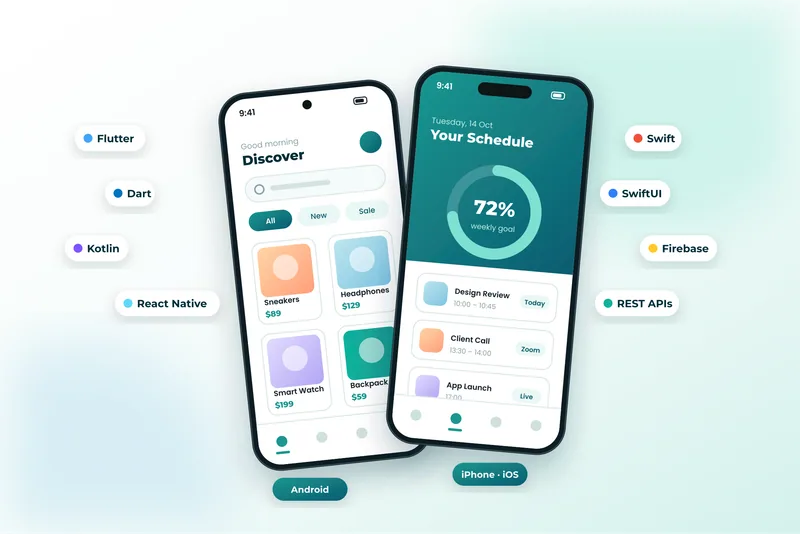
Two native apps cost close to twice one. Cross-platform frameworks such as Flutter or React Native typically bring the second platform in for a fraction of that — the main reason they dominate commercial work.
5. Compliance
Healthcare, financial and children's apps carry requirements that affect architecture, logging, data storage and testing. This is real engineering work, not paperwork, as we found building a telehealth consultation app.
Realistic Ranges
- Simple app — content, forms, a handful of screens, minimal backend. Weeks of work.
- Standard business app — accounts, sync, notifications, payments, admin panel. A few months.
- Complex platform — real-time features, multiple roles, third-party integrations, compliance. Six months upwards, usually phased.
We deliberately avoid publishing fixed prices, because a number without your requirements attached is misleading. What we can do quickly is tell you which band you are in and why.
The Costs After Launch
Budgeting only for the build is the most common planning mistake. Every app carries ongoing costs: developer programme fees, servers and databases, third-party services, and — unavoidably — maintenance. Both platforms release yearly updates that break things, and an unmaintained app degrades within about eighteen months.
A sensible annual figure is a meaningful fraction of the original build, covering OS compatibility, security patches and small improvements. This is what ongoing maintenance and support exists to handle, and the same logic applies to websites, as we set out in our website maintenance checklist.
How to Spend Less, Sensibly
- Cut scope, not quality. Ship the one workflow that delivers value, then extend. A smaller finished app beats a large unfinished one.
- Consider a PWA first. If you do not need store presence or deep hardware access, a progressive web app may do the job for considerably less.
- Use one codebase. Unless you have a specific reason to go native, cross-platform halves the platform cost.
- Design before you build. Decisions made in a prototype are far cheaper than the same decisions made in code.
If you want a grounded estimate, send us a description of the app and its main user journeys. We will come back with a realistic range and, where we think the app is not the cheapest way to solve your problem, we will say so. You can also browse our mobile app development work to see comparable projects.