
Database Development
Database Development, Optimisation and Migration Services
Schema design, query and index tuning, migrations and search infrastructure across MySQL, PostgreSQL, MongoDB, Redis and Elasticsearch.
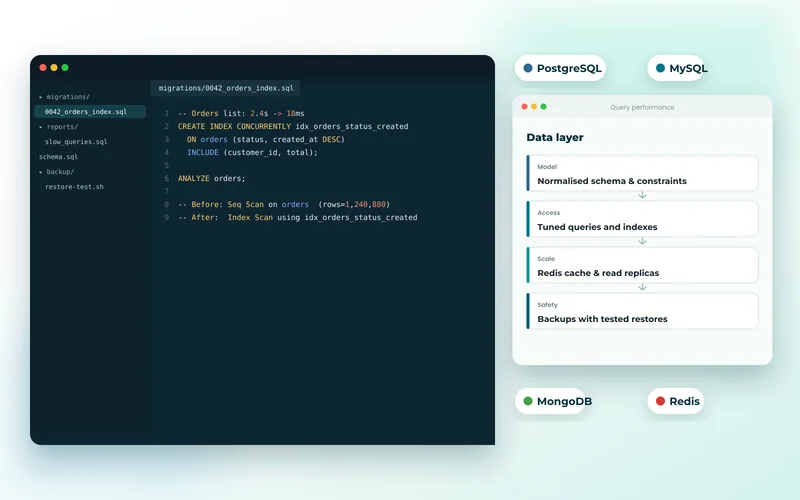
The Database Decides How Your Application Behaves Under Load
Almost every "the site is slow" investigation ends at the database. A missing index, a query fetching ten thousand rows to display twenty, a schema that made sense when the business was smaller, or a report running on the same server as checkout — these cost far more performance than any front-end tweak can recover.
We design schemas that model your business properly: normalised where integrity matters, denormalised where read speed matters, with the constraints, types and indexes that stop bad data getting in. Then we prove it with real query plans and load tests rather than assumptions.
We work across relational databases (MySQL, MariaDB, PostgreSQL, SQL Server) and non-relational stores (MongoDB, Redis, DynamoDB), and we add specialised engines where they earn their place — Elasticsearch or OpenSearch for search and faceting, InfluxDB for time-series metrics, Neo4j for relationship-heavy data.
What’s Included
What Our Database Work Covers
Schema & Data Modelling
Relational and document models with the right keys, constraints, data types and indexes from the start.
Query & Index Optimisation
Finding the slow queries, reading the execution plans and fixing the cause — often turning seconds into milliseconds.
Migrations & Platform Moves
MySQL to PostgreSQL, on-premises to cloud, or consolidating databases — with verification and a rollback plan.
Caching & Read Scaling
Redis caching layers, read replicas and connection pooling so reporting never slows down transactions.
Search Infrastructure
Elasticsearch or OpenSearch for fast, typo-tolerant, faceted search over large catalogues and document sets.
Backups, Replication & Recovery
Automated backups, point-in-time recovery, replication and — critically — tested restore procedures.
Benefits
What Good Database Work Delivers
- Pages and reports that stay fast as your data volume grows.
- Lower hosting costs, because efficient queries need far less hardware.
- Data integrity enforced by the database, not hoped for in application code.
- Recovery you have rehearsed, so an incident is an inconvenience rather than a crisis.
- Reporting that no longer competes with customers for the same resources.
Technologies Used for Database Development
We recommend the right tools for your goals, budget and team — never a one-size-fits-all stack.
Discuss Your ProjectHow We Work
Our Database Development Process
Discovery & Consultation
We learn about your business, audience and goals, review any existing website and agree on clear success criteria.
Strategy & Planning
We define the sitemap, features, technology stack and timeline, so scope and budget are clear before work begins.
UI/UX Design
We design wireframes and polished, responsive layouts for your approval, focused on usability and conversions.
Development
We build with clean, standards-based code, integrate your tools and set up an easy-to-use content editor.
Testing & QA
We test functionality, speed, security, accessibility and SEO across browsers and devices before launch.
Launch & Support
We deploy, monitor and fine-tune your site, then provide ongoing maintenance and support as you grow.
FAQ
Database Development FAQs
Our site slows down at peak times — is the database the cause?
Frequently, yes. We capture slow query logs during a peak, read the execution plans and identify the specific queries and missing indexes responsible, then fix and re-measure so you can see the difference.
MySQL or PostgreSQL?
PostgreSQL has richer types, stronger analytical features and excellent JSON support; MySQL and MariaDB are ubiquitous, simple to host and perfectly capable for most web workloads. Migration between them is realistic but not free, so we only recommend it when the benefit is concrete.
Do we need MongoDB?
Sometimes — for genuinely document-shaped, schema-variable data. Often a relational database with JSON columns gives the same flexibility while keeping joins and constraints. We will recommend based on your actual access patterns.
Can you migrate our database without downtime?
In most cases we can get very close, using replication to keep the new database in sync and switching over in a short, planned window with a tested rollback.
Explore More
More Cloud, Data & AI Services
Technologies and services that work well alongside database development.
Cloud Hosting & DevOps
AWS, Azure, Google Cloud and DigitalOcean setup, Docker and Kubernetes, CI/CD pipelines, Nginx tuning, monitoring, backups and cost optimisation.
AI Integration & LLM Development
Practical AI in your product — assistants, document understanding, search over your own content, and OCR or classification pipelines built with Python and modern LLM APIs.
Custom Web Development
Bespoke websites and web applications engineered around your workflows — fast, secure, and built to scale with your business.
Front-End Development
Pixel-accurate, accessible front ends built from your designs with HTML5, CSS3, JavaScript, Tailwind or Bootstrap — responsive on every device.
Database Development Enquiry
Tell Us About Your Database
Tell us which database you run, how large it is and what is slow, so we can target the investigation.
- Reply within 24 hoursA real person reviews every request.
- Free consultationHonest advice, no obligation.
- 100% confidentialHappy to sign an NDA.
- We review your requirements
- We reply with questions or a call slot
- You receive a clear, itemised proposal