A live dispatch board built in React and Node.js that replaced a spreadsheet-and-phone workflow for 120 drivers.
View live demo Opens a working demo with sample content in a new tab.
On location
Semi trucks line up to pickPhoto: U.S. Department of Agriculture (CC0)
View road windscreenPhoto: Markus Spiske (CC0)
Semi truckCC0 photo
Semi truckCC0 photo
Container StackPhoto: Bob Richards (CC0)
About the Project
This case study describes custom freight dispatch software built for a regional freight and courier operator running around 120 drivers. Dispatch had been managed with a shared spreadsheet, a phone that never stopped ringing, a WhatsApp group and a paper diary. It worked when the fleet was small, but as it grew past a hundred vehicles, planners lost track of where drivers were and late deliveries were being discovered by customers before the operator knew about them.
We replaced that patchwork with a single real-time dispatch board in React and TypeScript, backed by a Node.js API, WebSockets, PostgreSQL and Redis. Drivers use a lightweight mobile web view, and every status change, position update and proof of delivery appears on every planner’s screen within moments.
About the Client
The client is a regional freight and courier operator moving consignments for business customers every day. Its planners assign loads, juggle last-minute changes and keep customers informed, while account handlers deal with queries, billing and the occasional dispute.
Growth was the problem. Each additional driver meant more calls, more spreadsheet edits and more chances for information to be out of date, and the operations team needed a tool that would scale with the fleet rather than against it.
Project Goals
Give every planner one live view of loads, drivers and exceptions.
Let drivers accept loads, capture proof of delivery and report delays from their phones.
Detect late deliveries automatically, before the customer calls.
Keep a complete, searchable history for billing, reporting and disputes.
Cut the time spent planning each shift.
Project Overview
The Challenge and Our Solution
The Challenge
Dispatch ran on a shared spreadsheet and a constantly ringing phone. Planners had no reliable view of where drivers were, customers were told "it should be there today", and every change had to be relayed by call. As the fleet grew past a hundred vehicles the approach stopped scaling, and late deliveries were being discovered by the customer rather than the operator.
Our Solution
We built a single-page dispatch board in React and TypeScript over a Node.js API, with WebSockets pushing position and status updates to every planner at once. Drivers use a lightweight mobile web view to accept loads, capture proof of delivery and flag delays, which updates the board instantly. Route and ETA data comes from a mapping provider, cached in Redis so repeated lookups cost nothing, and the whole history is stored in PostgreSQL for reporting and customer disputes.
A Real-Time Dispatch Board for Every Planner
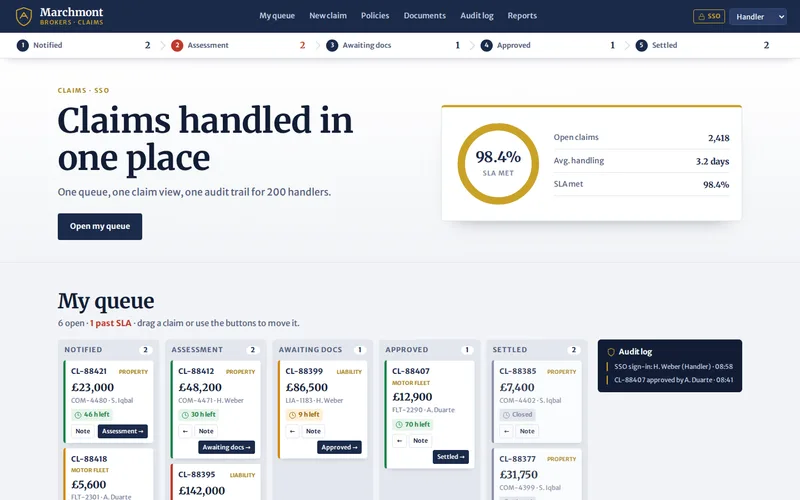
The dispatch board is a single-page React application showing loads, drivers and exceptions together. WebSockets push position and status updates from the Node.js API to every open board at the same time, so planners never refresh, never work from a stale copy and never overwrite each other’s changes the way they did in the shared spreadsheet.
Exceptions such as delays, failed deliveries and unassigned loads rise to the top, so the team spends its attention on what needs action. Planning time per shift fell from around three hours to under one.
Live loads, drivers and exceptions without refreshing
Simultaneous updates for every planner via WebSockets
Exceptions prioritised so problems are handled first
A Driver Tracking Platform Drivers Actually Use
Driver adoption makes or breaks any tracking system, so the driver view was designed for speed. From a lightweight mobile web view, drivers accept a load, navigate, capture a signature and photos as proof of delivery, and report a delay in two taps. Nothing needs installing, and the screens work on whatever phone the driver already carries.
Each action updates the board instantly. Proof of delivery is available to the customer service team within seconds, which means a customer asking “has it arrived?” gets a definite answer, with a photo, on the first call.
Automatic ETA Alerts and Exception Handling
Route and ETA data comes from a mapping provider. When a delivery is predicted to run late, the system raises an exception on the board and notifies the account handler, giving the team time to warn the customer or reallocate the load. Mapping lookups are cached in Redis, so repeated requests for the same route cost nothing and the board stays fast.
Delivery History for Billing, Reporting and Disputes
Every load has a full timeline stored in PostgreSQL: timestamps, positions, status changes, signatures and photos. When a customer queries an invoice or claims a delivery never arrived, the team can show exactly what happened and when. The same data powers operational reporting, helping managers see patterns in delays and plan capacity with evidence rather than instinct.
One system now replaces the spreadsheet, the WhatsApp group and the paper diary, giving the operator a single source of truth that grows with the fleet.
Our Process
How We Delivered It
1
Shadowing the Dispatch Desk
We spent time with planners and drivers to understand the real workflow, the calls, the workarounds and where information was being lost.
2
Data Model and Architecture
Loads, drivers, statuses and events modelled in PostgreSQL, with a Node.js API, WebSocket channels and Redis caching designed for real-time use.
3
Board and Driver View Build
The React and TypeScript dispatch board and mobile driver view developed in short iterations, with planners testing each release.
4
Parallel Running
The new board ran alongside the old process until planners and drivers were confident, avoiding any disruption to daily deliveries.
5
Go-Live and Optimisation
Full switchover, followed by tuning of alerts, reports and performance based on how the team used the platform day to day.
Key Features
What We Delivered
Live dispatch board
Loads, drivers and exceptions update in real time for every planner, without refreshing.
Driver mobile view
Accept, navigate, capture signatures and photos, and report a delay in two taps.
Automatic ETA alerts
Delays raise an exception on the board and notify the account handler before the customer calls.
Reporting & disputes
Full timeline per load — timestamps, positions and photos — for billing and claims.
Outcome
Results and Impact
Planning time per shift reduced from around three hours to under one.
Late deliveries flagged automatically instead of being reported by customers.
Proof of delivery available to the customer service team within seconds.
One board replaced a spreadsheet, a WhatsApp group and a paper diary.
Client Feedback
What the Client Says
★★★★★
Planning used to take three hours a shift and a lot of phone calls. The dispatch board replaced all of it, and our customers hear about a delay before they think to ask. Drivers took to it in a day, which told me the screens had been designed around them rather than around us.
Bespoke websites and web applications engineered around your workflows — fast, secure, and built to scale with your business.
Learn more
FAQ
Frequently Asked Questions
Why build custom freight dispatch software instead of buying a package?
Off-the-shelf tools suit standard workflows, but many operators have customer rules, exception handling and reporting needs that packages handle poorly. Custom software fits the way your planners already work, integrates with your existing systems and can grow with the fleet, without per-seat licensing that rises every time you add drivers.
Do drivers need to install an app?
Not in this project. Drivers use a lightweight mobile web view that runs in the phone’s browser, so there is nothing to install or update. Where operators need offline working, background location or scanner hardware, we can build a native or Flutter driver app instead.
How does real-time tracking work on the dispatch board?
Driver actions and position updates are sent to a Node.js API, which pushes them to every open board over WebSockets. Planners see changes within moments without refreshing, and everyone works from the same live data instead of separate copies of a spreadsheet.
Can a dispatch platform integrate with our existing systems?
Yes. Through REST APIs we can connect dispatch software to order systems, accounting and invoicing, customer portals, telematics devices and mapping providers. We review your current tools during discovery and plan integrations so data is entered once and flows where it is needed.
What affects the cost and timeline of logistics software?
Key factors include the number of user roles, real-time and mapping requirements, integrations with existing systems, offline needs for drivers, reporting depth and data migration. Building in stages, starting with the dispatch board and driver view, delivers value early while later features follow.
How is the platform supported after launch?
We provide ongoing support covering monitoring, security updates, performance tuning and new features. Because dispatch is business-critical, we agree response times for urgent issues and plan releases around your operating hours so updates never interrupt live deliveries.
Similar Work
Related Projects
Case studies built with the same technologies or for similar needs.