
NestJS Development
NestJS Backend, API & Microservices Development
Structured, testable Node.js backends with NestJS: REST and GraphQL APIs, microservices, queues and real-time services built to be maintained.
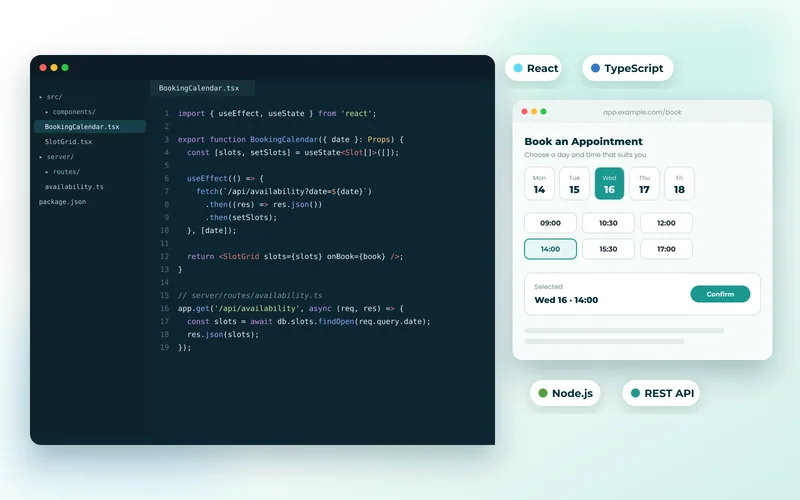
Node.js Backends That Stay Maintainable
Plain Node.js is quick to start and hard to keep tidy. NestJS gives a Node backend the structure of a mature framework — modules, dependency injection, validation, guards and a testing story — while keeping everything in TypeScript. It is what we reach for when an API has to be worked on by more than one person for more than one year.
We build NestJS services from scratch and take over existing ones: REST and GraphQL APIs, authentication, role-based access, queues, scheduled jobs, WebSocket gateways and microservices talking over Redis, RabbitMQ or Kafka. Every service ships with automated tests, generated API documentation and a repeatable deployment.
What’s Included
What We Build With NestJS
REST & GraphQL APIs
Versioned endpoints with validation, pagination, filtering and OpenAPI or GraphQL schema documentation generated from the code.
Authentication & Authorisation
JWT, sessions, OAuth and SSO logins with role- and permission-based guards on every route.
Microservices & Messaging
Services split along business lines, communicating over Redis, RabbitMQ or Kafka, with retries and dead-letter handling.
Real-time Gateways
WebSocket gateways for live dashboards, chat, notifications and tracking, scaled across instances.
Queues & Scheduled Jobs
BullMQ workers for email, exports, imports and long-running processing, with monitoring and retry policies.
Testing & Deployment
Unit and end-to-end tests, Docker images, CI pipelines and zero-downtime deploys to your cloud or ours.
Benefits
Why Teams Choose NestJS With Us
- A codebase new developers can navigate in a day, because it follows NestJS conventions rather than one person’s habits.
- TypeScript end to end, often sharing types with a React, Next.js or mobile front end.
- Test coverage on the business logic that matters, so changes can be made with confidence.
- Runs anywhere Node runs — a single VPS, Docker, Kubernetes or serverless.
- Existing Express applications can be migrated into NestJS incrementally.
Technologies Used for NestJS Development
We recommend the right tools for your goals, budget and team — never a one-size-fits-all stack.
Discuss Your ProjectHow We Work
Our NestJS Development Process
Discovery & Consultation
We learn about your business, audience and goals, review any existing website and agree on clear success criteria.
Strategy & Planning
We define the sitemap, features, technology stack and timeline, so scope and budget are clear before work begins.
UI/UX Design
We design wireframes and polished, responsive layouts for your approval, focused on usability and conversions.
Development
We build with clean, standards-based code, integrate your tools and set up an easy-to-use content editor.
Testing & QA
We test functionality, speed, security, accessibility and SEO across browsers and devices before launch.
Launch & Support
We deploy, monitor and fine-tune your site, then provide ongoing maintenance and support as you grow.
FAQ
NestJS Development FAQs
When is NestJS the right choice over plain Express?
When the backend will grow: several developers, many endpoints, background jobs, or a long lifespan. For a small single-purpose API, Express or a serverless function may be enough, and we will say so.
Can you take over an existing NestJS project?
Yes. We start with a review of the module structure, tests and deployment, fix anything blocking you, and then continue development or provide ongoing support.
Does NestJS work with our database?
NestJS works with PostgreSQL, MySQL, MongoDB, SQL Server and others through TypeORM, Prisma or Mongoose. We choose the data layer to fit the database you already have.
How is a NestJS backend deployed?
Usually as a Docker container behind Nginx, on a VPS, AWS, Azure or Google Cloud, with a CI pipeline that runs the tests and deploys on merge. Serverless deployment is possible for lighter workloads.
Explore More
More Frameworks & Languages Services
Technologies and services that work well alongside nestjs development.
React Development
Custom React.js front ends, dashboards and single-page applications built with TypeScript, reusable components and server-side rendering for SEO.
Next.js Development
Next.js websites and web apps with server-side rendering, static generation, image optimisation and route-level code splitting for top Core Web Vitals.
Vue.js & Nuxt Development
Vue 3 applications and server-rendered Nuxt websites — Composition API, Pinia state, TypeScript and fast, SEO-ready pages.
Angular Development
Angular applications for large teams — typed architecture, RxJS data flows, standalone components, testing and long-term upgrade support.
NestJS Development Enquiry
Tell Us About the Backend You Need
A few details about the API and what will use it help us size the work.
- Reply within 24 hoursA real person reviews every request.
- Free consultationHonest advice, no obligation.
- 100% confidentialHappy to sign an NDA.
- We review your requirements
- We reply with questions or a call slot
- You receive a clear, itemised proposal