




SaaS Product Development

Field-Service Quoting SaaS

A Rails MVP taken from idea to paying subscribers in ten weeks, with Stripe billing and Hotwire interactivity.

View live demo Opens a working demo with sample content in a new tab.
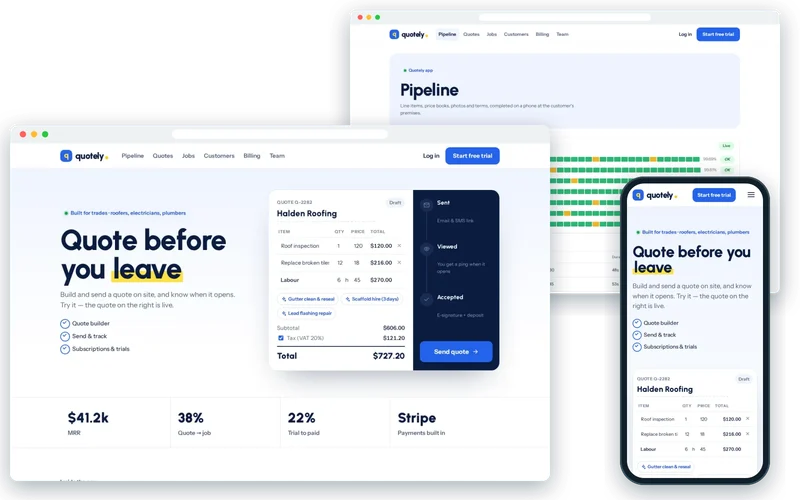
Quotely demo on desktop and phone

On location

  • Tools Workshop — Quotely
    Tools WorkshopPhoto: Barn Images (CC0)
  • Tools People — Quotely
    Tools PeoplePhoto: m0851 (CC0)
  • Wood Tools — Quotely
    Wood ToolsPhoto: Todd Quackenbush (CC0)
  • Construction Tools — Quotely
    Construction ToolsPhoto: The World is a Stage (CC0)
  • Tools Hammer — Quotely
    Tools HammerPhoto: energepic.com (CC0)

About the Project

This was a Ruby on Rails MVP development project with a deadline set by a startup’s runway. The founders had already validated their problem: trades businesses — roofers, electricians, plumbers, tree surgeons — were losing work because quotes took days to arrive. By the time a tidy quote reached the customer, a competitor who quoted on the spot had often won the job.

The risk was not building the wrong thing so much as building too much. We scoped the product down to one workflow that customers would pay for: create a quote on site, send it before leaving the driveway, and know when the customer opens it. The product reached a private beta in week six and paying customers in week ten.

About the Client

The client is a field-service software startup founded by people who knew the trades well. They had customer interviews, a clear problem statement and a limited runway — enough to build one product properly, not three half-products.

They needed a partner who would push back on scope, choose technology that let a small team move quickly, and put a real, billable product in front of customers early enough to learn from them.

Project Goals

  • Ship the smallest product people would pay for, as early as possible.
  • Let tradespeople build and send a quote on a phone while still on site.
  • Show when a quote has been opened and follow up automatically.
  • Handle trials, subscriptions and failed payments without manual work.
  • Support company accounts with team members and isolated data.

Project Overview

The Challenge and Our Solution

The Challenge

The founders had validated the problem — trades businesses losing work because quotes took days — but needed a real product in front of customers before their runway made the question academic. The temptation was to build everything; the requirement was to build the smallest thing people would pay for.

Our Solution

We scoped hard to one workflow: create a quote on site, send it while still there, and know when the customer opens it. Rails gave us accounts, authentication, multi-tenancy and background jobs without ceremony, and Hotwire delivered the live, app-like interactions without a separate front-end codebase. Stripe handled trials, subscriptions and dunning. We shipped to a private beta in week six and to paying customers in week ten.

Field Service Quoting Software Built for the Driveway

The quote builder is designed for a phone held in one hand at a customer’s door. Line items come from a price book, so common jobs take seconds; photos and terms attach to the quote; and the total, including tax, updates as items are added. Nothing requires a laptop or a return to the office.

Quotes are sent by email and SMS while the tradesperson is still on site, which is exactly the moment the founders’ research showed mattered most.

  • Price books for fast line items
  • Photos and terms attached on site
  • Send by email or SMS before leaving

Knowing When a Quote Is Opened

Every quote carries open tracking, so the tradesperson sees when a customer has viewed it and can call at the right moment rather than guessing. Automatic follow-up reminders go out if a quote sits unopened or unanswered, which recovers work that would otherwise quietly go elsewhere.

Accepted quotes become jobs, giving the business a simple pipeline from first visit to booked work. Early customers reported quote-to-job conversion of 38%.

  • Open tracking on every quote
  • Automatic follow-up reminders
  • Accepted quotes flow into jobs

Hotwire Instead of a Separate Front End

Rails gave us accounts, authentication, multi-tenancy and background jobs without ceremony, and Hotwire — Turbo and Stimulus — delivered the live, app-like interactions the quote builder needed without a separate JavaScript application.

For a startup, that matters beyond speed of delivery: there is one codebase to fund and maintain, one deployment, and one set of skills to hire for. Sidekiq and Redis handle background work such as sending quotes and reminders.

  • Rails for accounts, auth and multi-tenancy
  • Turbo and Stimulus for live interactions
  • One codebase — no separate front end

SaaS Subscription Billing With Stripe

Stripe handles free trials, plan changes with proration, and dunning for failed payments, with a self-service billing portal so customers manage their own cards and invoices. Billing is not a feature customers buy, but getting it wrong costs revenue and support time from day one.

The result was a business that could charge from launch: the first paying subscribers arrived ten weeks after the project started, and trial-to-paid conversion reached 22% in the first quarter.

  • Trials, proration and dunning
  • Self-service billing portal
  • Charging customers from launch

Our Process

How We Delivered It

  1. Cutting Scope to One Workflow

    We worked through the founders’ research and agreed the single workflow customers would pay for, parking everything else.

  2. Designing for a Phone on Site

    Quote screens were designed for one-handed use on a doorstep, then tested with tradespeople.

  3. Building in Rails and Hotwire

    Accounts, tenancy, the quote builder, sending and tracking were built in short iterations with a demo every week.

  4. Private Beta in Week Six

    A small group of trades businesses used the product on real jobs, and their feedback shaped the remaining weeks.

  5. Billing and Paid Launch

    Stripe trials and subscriptions went live and paying customers were onboarded in week ten.

Key Features

What We Delivered

  • Quote builder

    Line items, price books, photos and terms, completed on a phone at the customer’s premises.

  • Send & track

    Quotes delivered by email and SMS with open tracking and automatic follow-up reminders.

  • Subscriptions & trials

    Stripe plans with free trials, proration, dunning and a self-service billing portal.

  • Multi-tenant accounts

    Company accounts with roles, team members and per-tenant data isolation.

Outcome

Results and Impact

  • First paying subscribers ten weeks after the project started.
  • One codebase — no separate front-end application to fund or maintain.
  • 22% trial-to-paid conversion in the first quarter after launch.
  • Quote-to-job conversion of 38% reported across early customers.

Client Feedback

What the Client Says

★★★★★

Ten weeks of runway, one workflow, paying customers at the end of it.

Co-founderField-service software startup

Services

Services Behind This Project

The Ruby on Rails, Docker & Kubernetes expertise we used to build this saas product development — and can bring to yours.

  • Ruby on Rails Development

    Rails applications and MVPs built quickly and cleanly — Hotwire interfaces, background jobs, Stripe billing and upgrades of existing Rails code.

  • Docker & Kubernetes

    Applications packaged in Docker, deployed with CI/CD, and run on Kubernetes when they need to scale — with monitoring, secrets and rollbacks built in.

FAQ

Frequently Asked Questions

Why use Ruby on Rails for an MVP?

Rails includes the building blocks most SaaS products need — authentication, accounts, background jobs, mailers — and favours convention over configuration, so a small team can deliver working features quickly. With Hotwire, it can also deliver app-like interfaces without a separate front-end codebase.

What is Hotwire and how does it help?

Hotwire combines Turbo and Stimulus to update pages live from the server with minimal JavaScript. It gives users a responsive, app-like experience while keeping one codebase, which reduces cost and complexity for a startup compared with maintaining a separate single-page application.

How do you decide what goes into an MVP?

We start from the problem customers will pay to solve and identify the shortest workflow that solves it end to end. Everything else is listed, prioritised and deferred. The aim is a product that is small but complete and billable, so you learn from real customers as early as possible.

Can the product grow beyond the MVP?

Yes. Rails applications scale well with good structure, and multi-tenancy, background jobs and billing were built properly from the start. New workflows such as scheduling or invoicing can be added on the same foundation without rewriting it. The same discipline that kept the MVP small also kept its code clean, which is what makes later features straightforward to add.

How is multi-tenant data kept separate?

Every record belongs to a company account, and data access is scoped to the signed-in user’s company throughout the application. Roles control what each team member can see and do, so one customer’s quotes and contacts are never visible to another.

What affects the cost and timeline of a SaaS MVP?

The biggest factors are scope, the number of user roles, integrations such as payments or messaging, and how much design polish is needed for launch. A tightly scoped MVP like this one can reach paying customers in around ten weeks; broader scopes take proportionally longer.

Similar Work

Related Projects

Case studies built with the same technologies or for similar needs.

  • Semi trucks line up to pick — Northline Freight
    • React
    • TypeScript
    • Node.js

    Web Application Development

    Freight Dispatch & Driver Tracking Platform

    A live dispatch board built in React and Node.js that replaced a spreadsheet-and-phone workflow for 120 drivers.

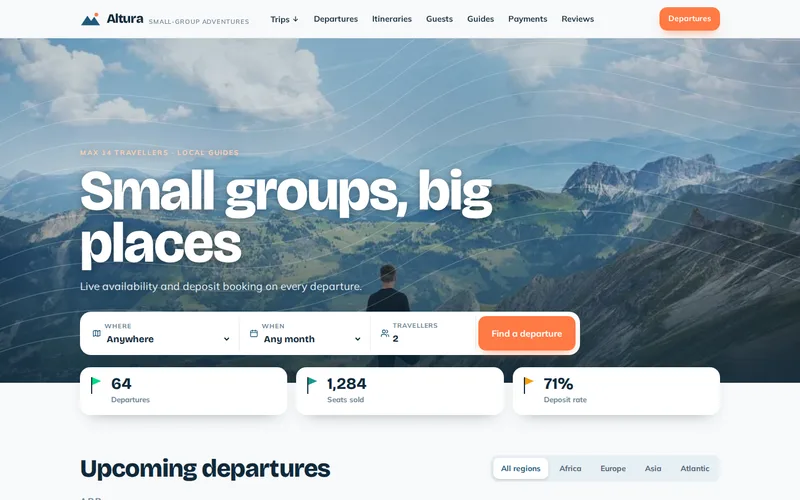
  • Guy Man — Altura Tours
    • Vue 3
    • Nuxt
    • TypeScript

    Booking Platform Development

    Adventure Tour Booking & Itinerary Platform

    A Vue 3 and Nuxt platform handling departures, seat availability, deposits and guide assignments for multi-day tours.

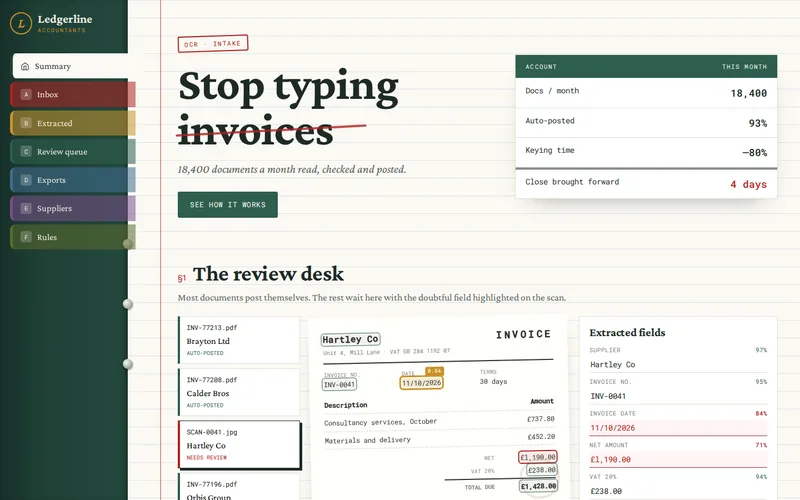
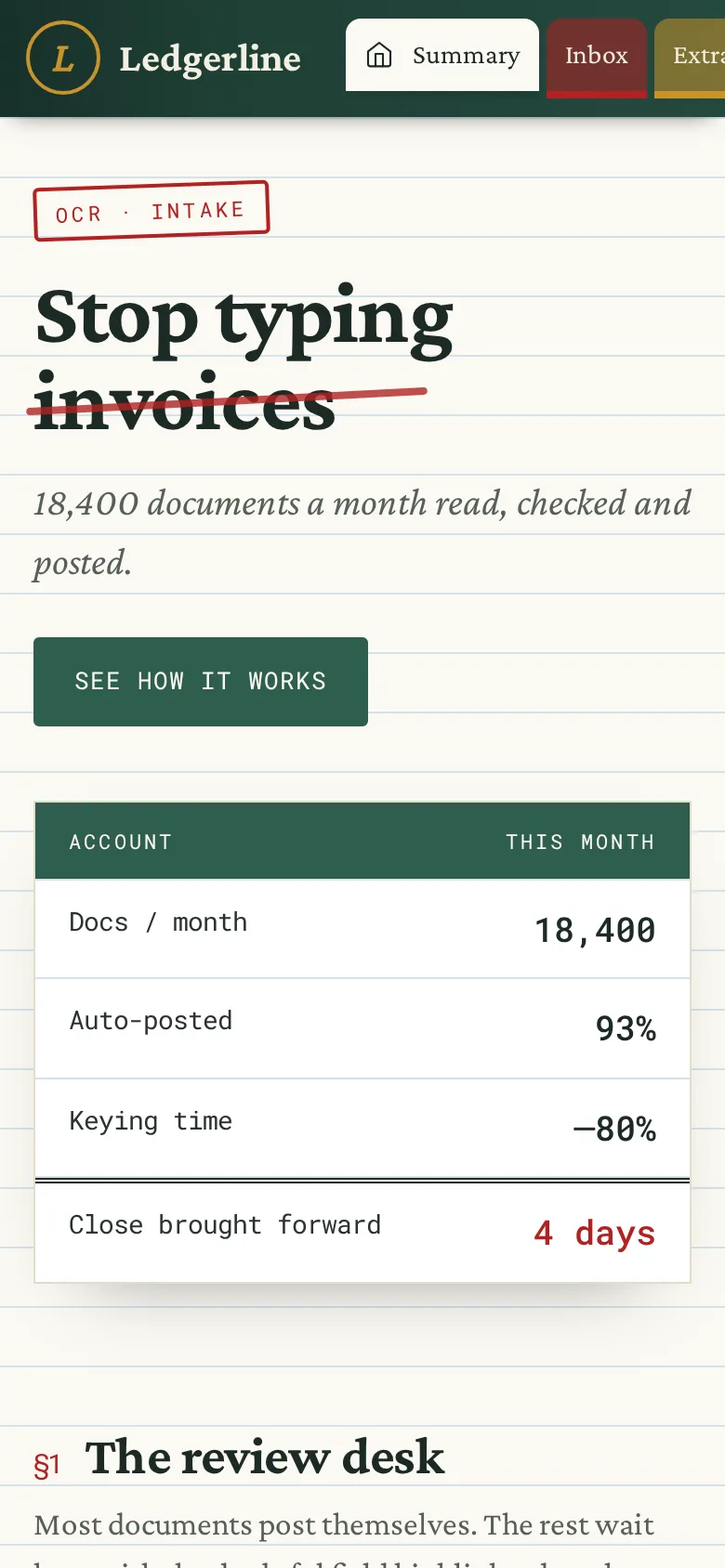
  • Accounting Finance — Ledgerline Accountants
    • Python
    • FastAPI
    • Tesseract OCR

    Data Automation & OCR

    Invoice Processing & OCR Automation

    A Python pipeline that reads 18,400 supplier documents a month and posts 93% of them without a person keying anything.

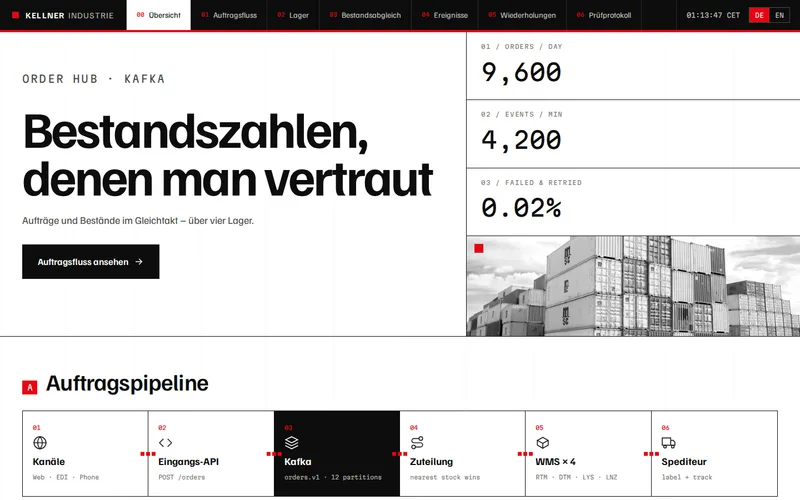
  • Containers Bins — Kellner Industrie
    • Java 21
    • Spring Boot
    • Spring Batch

    Enterprise Integration

    Warehouse Order Service & Event Integration

    A Spring Boot order service processing 9,600 orders a day across four warehouses, with event-driven stock sync.

  • Antique Watch — Ridgemont Auctions
    • Elixir
    • Phoenix Channels
    • Go

    Real-Time Web Platform

    Live Auction Bidding Platform

    An Elixir and Go platform holding 11,000+ concurrent bidders per sale with bid latency measured in milliseconds.

  • Bricks Wall — Barrow Building Supplies
    • Node.js
    • NestJS
    • TypeScript

    API & ERP Integration

    ERP to Web Shop Integration

    A NestJS integration layer moving 312,000 messages a day between an ERP, a web shop and the accounts system.

Let’s Connect

Want Results Like These?

Share your project details and our experts will get back to you within one business day with the best solution — free consultation, no obligation.