
Go, Rust & Elixir Development
Go, Rust and Elixir Development for High-Performance Services
Services where throughput, latency or concurrency matter — Go APIs and workers, Rust for performance-critical code, Elixir and Phoenix for real-time systems.
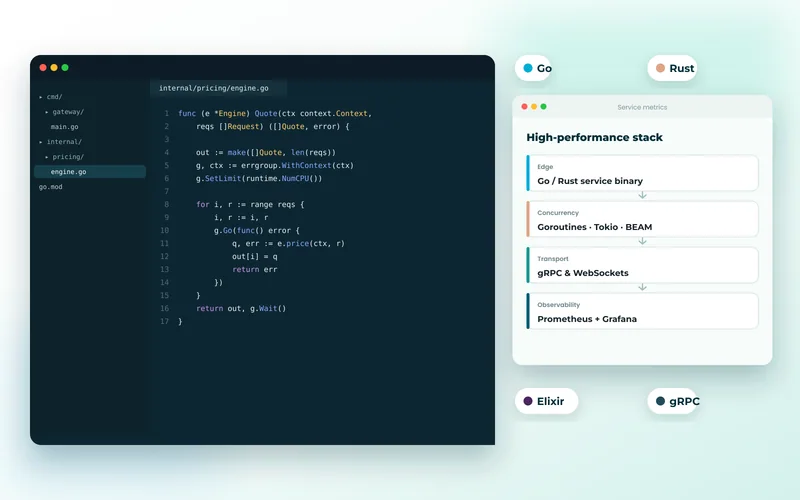
When Throughput, Latency or Concurrency Decide the Architecture
Most business applications never need this tier — and we will say so. But some do: an API taking thousands of requests a second, a pricing or matching engine where milliseconds are money, a platform holding hundreds of thousands of live connections, or a worker chewing through a data firehose on hardware you would rather not triple.
Go is our usual first answer. It compiles to a single binary, starts instantly, handles concurrency cleanly with goroutines and is easy to operate and hire for. Rust comes in where memory safety and raw speed both matter — parsers, cryptography, media processing or a hot component inside a larger system. Elixir and Phoenix win where a platform is fundamentally real-time: chat, presence, telemetry and live dashboards, where the BEAM runtime’s fault tolerance is hard to match.
We are deliberate about this choice. These languages carry a smaller hiring pool and a steeper onboarding cost, so we use them where the numbers justify it, keep the surface area focused, and document the service so your existing team can operate it.
What’s Included
What We Build in Go, Rust and Elixir
Low-Latency APIs
Go or Rust services built for predictable response times under sustained load, with benchmarks to prove it.
Concurrent Workers & Pipelines
High-throughput ingestion, transformation and queue consumers that keep up without a fleet of servers.
Real-Time Platforms in Phoenix
Chat, presence, live dashboards and collaborative features over WebSockets with Phoenix Channels and LiveView.
gRPC & Internal Services
Typed service-to-service contracts with protocol buffers, streaming and clear versioning.
Performance-Critical Components
Rust modules for parsing, encoding, imaging or cryptography, callable from Node.js, Python or Elixir.
Profiling & Load Testing
Measuring before and after — CPU and memory profiles, load tests and capacity plans instead of guesswork.
Benefits
What This Tier Actually Buys You
- Far more work done per server, which shows up directly in hosting cost.
- Predictable latency under load rather than performance that degrades with traffic.
- Go binaries deploy as a single file with no runtime to install or patch.
- Rust removes whole classes of memory bugs at compile time.
- Elixir keeps hundreds of thousands of live connections on modest hardware, and isolates failure.
Technologies Used for Go, Rust & Elixir Development
We recommend the right tools for your goals, budget and team — never a one-size-fits-all stack.
Discuss Your ProjectHow We Work
Our Go, Rust & Elixir Development Process
Discovery & Consultation
We learn about your business, audience and goals, review any existing website and agree on clear success criteria.
Strategy & Planning
We define the sitemap, features, technology stack and timeline, so scope and budget are clear before work begins.
UI/UX Design
We design wireframes and polished, responsive layouts for your approval, focused on usability and conversions.
Development
We build with clean, standards-based code, integrate your tools and set up an easy-to-use content editor.
Testing & QA
We test functionality, speed, security, accessibility and SEO across browsers and devices before launch.
Launch & Support
We deploy, monitor and fine-tune your site, then provide ongoing maintenance and support as you grow.
FAQ
Go, Rust & Elixir Development FAQs
Do we actually need Go, Rust or Elixir?
Often not, and we will tell you when a well-tuned Node.js, Laravel or Django service will comfortably handle your load for far less money. These languages are worth it when measurements — not assumptions — show the current stack cannot meet your latency or concurrency targets economically.
Can one of these services sit inside our existing system?
Yes, and that is the usual approach. We isolate the hot path into a Go or Rust service behind a clear API, leave the rest of your stack untouched, and hand over runbooks so it is straightforward to operate.
Who maintains it afterwards?
We keep the service small, documented and heavily tested so your team can own it, and we offer a support retainer if you would rather we stayed responsible for that component.
Go or Rust for a new API?
Go, in nearly all cases — it is faster to write, easier to hire for and quick enough for the vast majority of workloads. Rust is worth the extra effort for CPU-bound work or where memory safety is a hard requirement.
Explore More
More Frameworks & Languages Services
Technologies and services that work well alongside go, rust & elixir development.
React Development
Custom React.js front ends, dashboards and single-page applications built with TypeScript, reusable components and server-side rendering for SEO.
Next.js Development
Next.js websites and web apps with server-side rendering, static generation, image optimisation and route-level code splitting for top Core Web Vitals.
Vue.js & Nuxt Development
Vue 3 applications and server-rendered Nuxt websites — Composition API, Pinia state, TypeScript and fast, SEO-ready pages.
Angular Development
Angular applications for large teams — typed architecture, RxJS data flows, standalone components, testing and long-term upgrade support.
Go, Rust & Elixir Development Enquiry
Tell Us About Your Performance Requirements
Tell us the load you need to handle and what is failing today — we will tell you honestly whether this tier is worth it for you.
- Reply within 24 hoursA real person reviews every request.
- Free consultationHonest advice, no obligation.
- 100% confidentialHappy to sign an NDA.
- We review your requirements
- We reply with questions or a call slot
- You receive a clear, itemised proposal