Frameworks & Languages
Go, Rust and Elixir: When Specialist Languages Are Worth It
Three languages that solve specific problems extremely well. Using them for the right reason is valuable; using them for novelty is expensive.
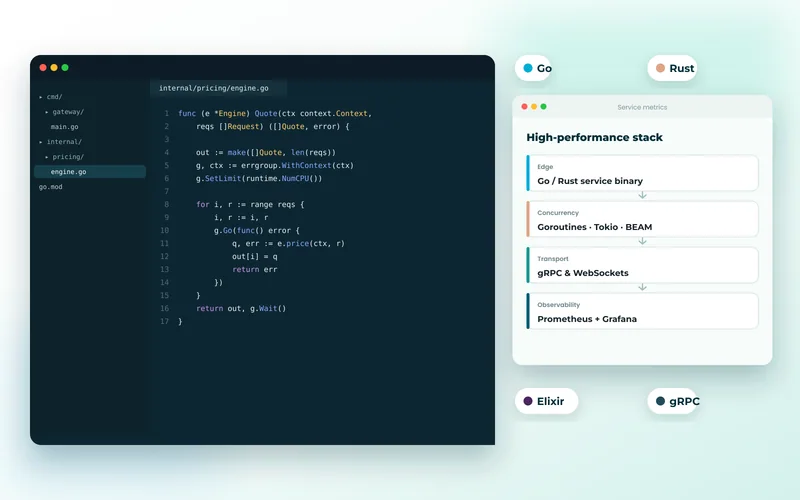
Most web applications should be built in a mainstream language with a large hiring pool. That is not a lack of ambition — it is what keeps a system maintainable after the people who built it have moved on. But there are problems where a specialist language is genuinely the right answer, and it is worth knowing which.
Go
Go was designed for building network services that many people maintain. It is deliberately small: few features, one obvious way to do most things, and a formatter that ends style arguments permanently. New developers become productive in days rather than months.
It compiles to a single binary with no runtime to install, starts instantly and uses little memory — ideal for containers and anything that scales up and down. Concurrency is built into the language rather than bolted on.
Use it for API services, infrastructure tooling, CLI utilities and anything where deployment simplicity and efficiency matter. Do not use it where you want rich abstractions; Go's verbosity is intentional and can grate on business logic with many rules — that work is usually better in Laravel or Spring Boot.
Rust
Rust offers memory safety without a garbage collector, enforced by the compiler. The result is performance comparable to C with a whole class of crashes and vulnerabilities made impossible at compile time.
The cost is the learning curve, which is real. The borrow checker rejects code that would be fine in other languages, and productivity drops before it rises. That is a worthwhile trade when performance or safety is a hard requirement — embedded systems, cryptography, data processing at volume, or components where a memory bug would be a security incident.
It is rarely the right choice for an ordinary web application. Writing CRUD in Rust is possible and almost always slower to deliver than the alternatives.
Elixir
Elixir runs on the Erlang VM, built at Ericsson for telephone switches that were not allowed to go down. It handles enormous numbers of lightweight concurrent processes, isolates failures so one crash does not take the system with it, and supports distribution across machines natively.
For messaging platforms, real-time systems with very many connections, and anything where fault tolerance is a product requirement rather than an aspiration, it is outstanding. Phoenix LiveView also offers a compelling way to build interactive interfaces without a separate JavaScript application.
For more conventional real-time needs, Node.js reaches a similar place with a far larger hiring pool — we cover that in Node.js for real-time features.
The Question to Ask First
Before adopting any of these, answer honestly: is the problem you have actually the problem this language solves? Most performance complaints turn out to be missing database indexes, not language speed — see why sites slow down as they grow. Switching language to fix a query problem is an expensive way to not fix it.
The second question is who maintains it. A service in a language only one person on the team knows is a risk, however elegant.
Using Them Sparingly
The most effective pattern we see is a mainstream stack with one specialist component: a Go service handling a high-volume endpoint, a Rust library for a heavy computation, an Elixir service for the real-time layer. The bulk of the system stays approachable, and the specialist language is applied where it pays.
That approach depends on clean boundaries, which makes API development and integration the foundation, and sensible deployment through cloud and DevOps services.
Considering one of these? Tell us the problem you are trying to solve and we will tell you whether a specialist language is warranted — or whether the bottleneck is somewhere else entirely. See also our Go, Rust and Elixir work.