Frameworks & Languages
NestJS vs Express: When a Node.js Backend Needs Structure
Express gets a Node API running in an afternoon. NestJS is what keeps it maintainable three years and three developers later. Here is how to tell which one your project needs.
Express is deliberately minimal. It gives you routing and middleware and leaves every other decision — how to organise code, validate input, handle errors, test, or talk to a database — to you. That freedom is wonderful for a small service and a real problem once the codebase and the team both grow.
What Goes Wrong With Unstructured Express
The pattern is familiar from many backends we take over. Route handlers grow to hundreds of lines. Validation is done differently in each file, if at all. Business logic is mixed with HTTP concerns, so nothing can be tested without spinning up a server. Three developers have three styles, and there is no API documentation because nothing generates it.
None of this is Express's fault. It is what happens when a framework makes no decisions and a team under deadline pressure does not make them either.
What NestJS Decides for You
NestJS sits on top of Express (or Fastify) and adds the structure a long-lived backend needs:
- Modules group related controllers, services and providers, so a feature lives in one place.
- Dependency injection makes services testable in isolation and swappable in tests.
- Pipes and guards handle validation and authorisation in one consistent way on every route.
- Decorators generate OpenAPI documentation from the code, so the docs cannot drift.
- Built-in support for queues, scheduling, WebSockets and microservice transports.
It is all TypeScript, which is why our NestJS development work so often pairs with a React or Next.js front end sharing the same types.
When Express Is Still the Right Call
A single-purpose service, a webhook receiver, a prototype, or a function that will run serverless does not need NestJS. The structure has a cost — more files, more concepts to learn — and for a 300-line API it is overhead. Our general Node.js development work still uses plain Express or Fastify for these.
The Point Where Structure Pays
In our experience the crossover comes early: more than one developer, more than a couple of dozen endpoints, or any expectation the service will still be worked on in two years. Past that point NestJS saves more time than it costs, mostly by making the codebase legible to whoever touches it next.
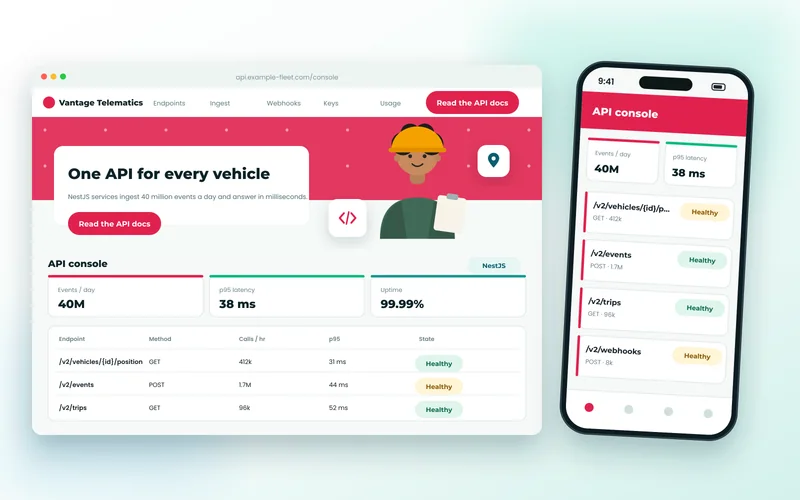
A telematics provider we worked with had exactly this problem: six years of Express written by three teams in three styles. Rebuilt as NestJS services, the same platform now ingests 40 million events a day, partners integrate in days rather than weeks because the documentation is generated, and any team can work on any service.
Migrating Without a Rewrite
You do not have to throw the Express application away. NestJS can mount existing Express routers, so the usual approach is to put NestJS in front, move endpoints across module by module, and retire the old code as it empties. It is the same incremental strategy we use for any API development and integration project where a live system cannot stop.
Deployment
A NestJS service is just a Node process, so it runs anywhere: a single server, a container, or a Kubernetes cluster when the load justifies it. For anything with several services we usually pair it with Docker and, where warranted, Kubernetes, with tests running in CI before every deploy.
If you have a Node backend that has become hard to change, tell us about it. A short review will show whether it needs structure, or just a tidy-up. For real-time features specifically, our piece on Node.js for real-time features covers the WebSocket side.