




Hybrid App Development

Home Care Visit Logging App

An Ionic and Capacitor app built from the provider’s existing Angular system, in the stores in seven weeks.

View live demo Opens a working demo with sample content in a new tab.
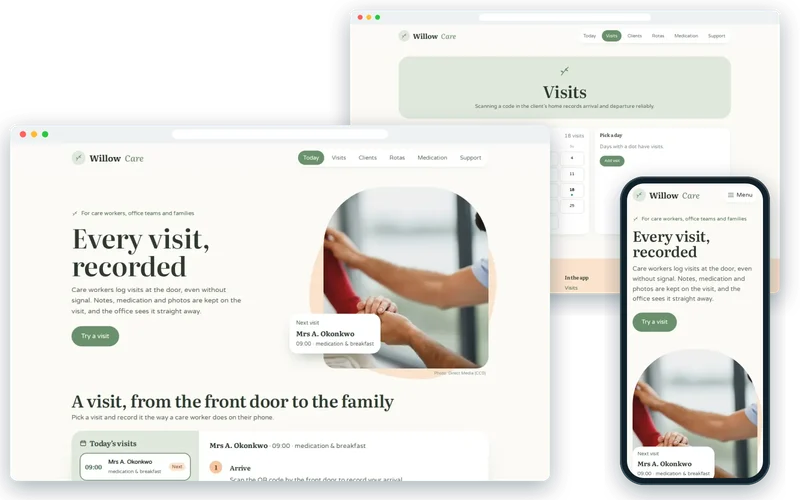
Willow Care demo on desktop and phone

On location

  • Senior Couple — Willow Care
    Senior CouplePhoto: Senior Living (CC0)
  • Caregiver Nurse — Willow Care
    Caregiver NursePhoto: Direct Media (CC0)
  • Couple Park — Willow Care
    Couple ParkPhoto: Senior Living (CC0)
  • Happy Couple — Willow Care
    Happy CouplePhoto: Senior Living (CC0)
  • Old Elderly — Willow Care
    Old ElderlyPhoto: Raul Petri (CC0)

About the Project

This case study covers a home care visit logging app built with Ionic and Capacitor for a home healthcare provider. Care workers visit clients in their own homes several times a day, and every visit needs to be evidenced: when the worker arrived and left, what care was given, what medication was recorded and anything the office or family should know. Until this project, much of that arrived a week later on paper timesheets.

The provider already ran an Angular web application for its office teams. Rather than starting again, we packaged and extended that codebase into Android and iOS apps, adding QR arrival check-in, offline visit logs and schedule notifications. The app reached both app stores seven weeks after work began, visits are now confirmed in real time, and local-authority billing evidence is produced from the visit record automatically.

About the Client

The client is a home healthcare provider supporting older and disabled people to live independently at home. Its care workers travel between clients throughout the day, often into rural areas and buildings with little or no mobile signal.

Much of its work is funded by local authorities, which require evidence that each commissioned visit took place and lasted as planned. Paper timesheets made that evidence slow to collect, hard to check and easy to lose, and they left the office without a live picture of the day.

Project Goals

  • Record arrival and departure reliably at the client's door.
  • Let care workers record notes, medication and photo evidence during the visit, with or without signal.
  • Notify workers of new visits, changes and cancellations on both platforms.
  • Produce billing evidence for funders from the visit record itself.
  • Reuse the existing Angular application to reach the app stores quickly.

Project Overview

The Challenge and Our Solution

The Challenge

Care workers recorded visits on paper and posted timesheets weekly, so the office could not confirm a visit had happened until days later — a problem for both safeguarding and local-authority billing. The provider already ran an Angular web system and had neither the budget nor the team for two native apps.

Our Solution

We packaged the existing Angular application with Ionic and Capacitor, adapting navigation and layout for phone use and adding the native capabilities the work required: QR scanning to confirm arrival at the client’s home, offline storage for visit logs and medication records, and push notifications for schedule changes. Because roughly 70% of the code was already written and tested, the apps reached both stores in seven weeks.

QR Check-In for Care Workers at the Door

Each client's home has a QR code. Scanning it with the Capacitor barcode plugin records arrival, and scanning again on the way out records departure. The method is quick, works with gloves on and does not depend on GPS, which can be unreliable in flats and terraced streets.

Because arrival is captured at the door rather than written up later, the office sees visits confirmed as they happen, and late or missed visits can be followed up the same day.

  • Arrival and departure from a code in the home
  • No dependence on GPS accuracy
  • Live visit confirmation for the office

Offline Visit Logging That Syncs Later

Signal is often weakest exactly where care is delivered. Care notes, medication records and photo evidence are stored locally in SQLite on the phone, with photos captured through the Capacitor camera plugin, and synchronised automatically once a connection returns.

Care workers no longer have to stand in the street looking for signal, and nothing is lost if a visit happens in a dead zone. The record is complete when it reaches the office, just later.

From an Angular Web App to a Home Care App in Seven Weeks

The provider's office system was already written in Angular. Ionic and Capacitor let us reuse that code — its data models, validation and much of its interface — and package it as native Android and iOS apps, adding mobile-specific features through Capacitor plugins.

Fastlane automated builds and store submissions for both platforms. Reuse is what made the timeline possible: seven weeks from starting work to the app being available in both stores.

  • Existing Angular codebase reused
  • Native features through Capacitor plugins
  • Fastlane-automated store releases

Notifications and Billing Evidence

Firebase Cloud Messaging alerts care workers to new visits, changes and cancellations, so they are not working from an out-of-date rota. The office can adjust the day and know workers have been told.

Every visit record — times, tasks and notes — feeds the evidence the provider sends to local authorities, produced automatically rather than assembled from paper. Billing is faster, and queries can be answered from the record itself.

Our Process

How We Delivered It

  1. Shadowing Visits

    We joined care workers on rounds to understand the doorstep moment, signal blackspots and how notes were really written.

  2. Codebase Assessment

    The existing Angular application was reviewed to decide what could be reused directly and what needed mobile-specific work.

  3. Mobile Features

    QR check-in, offline SQLite storage, camera evidence and push notifications were added through Capacitor plugins.

  4. Field Pilot

    A group of care workers used the app on real rounds, including areas without signal, before the wider rollout.

  5. Store Release

    Fastlane pipelines built and submitted both apps, and the provider rolled the app out to its care teams.

Key Features

What We Delivered

  • QR arrival check-in

    Scanning a code in the client’s home records arrival and departure reliably.

  • Offline visit logs

    Care notes, medication records and photo evidence stored locally and synced later.

  • Schedule notifications

    Push alerts for new visits, changes and cancellations across both platforms.

  • Reused web codebase

    The provider’s existing Angular application packaged for Android and iOS.

Outcome

Results and Impact

  • Visits confirmed in real time instead of a week later by paper timesheet.
  • Local-authority billing evidence produced from the visit record automatically.
  • Seven weeks from start to both app stores, reusing the existing Angular code.
  • Care workers keep working in areas with no signal; logs sync afterwards.

Client Feedback

What the Client Says

★★★★★

Seven weeks from our existing Angular system to both app stores. Carers log visits at the door and the funder evidence writes itself.

Service ManagerHome healthcare provider

Services

Services Behind This Project

The Ionic & Capacitor Apps, Angular, Firebase expertise we used to build this hybrid app development — and can bring to yours.

  • Ionic & Capacitor Apps

    Hybrid Android and iOS apps built from your web stack with Ionic and Capacitor — reuse React, Angular or Vue code and ship to both stores.

  • Angular Development

    Angular applications for large teams — typed architecture, RxJS data flows, standalone components, testing and long-term upgrade support.

  • Firebase Development

    Web and mobile backends on Firebase — sign-in, Firestore data, Cloud Functions, push notifications and hosting — built with security rules and cost control from day one.

FAQ

Frequently Asked Questions

Why Ionic and Capacitor instead of a fully native app?

The provider already had a working Angular application. Ionic and Capacitor let us reuse that code and add native capabilities — camera, barcode scanning, local storage and notifications — through plugins. That reuse is why the app reached both stores in seven weeks rather than several months.

How does QR check-in compare with GPS geofencing?

GPS can drift in flats, terraced streets and rural areas, which leads to false alerts or missed check-ins. A QR code in the home proves the worker was at the door, works without location permissions and is quick to scan. Some providers combine both approaches.

What happens if there is no signal during a visit?

Everything the worker records is saved on the phone first and synchronised automatically when a connection returns. The worker can carry on with the visit and the next one without waiting, and the office receives the complete record once the phone is back online.

Is care data kept secure on the phone?

Data stored on the device is kept within the app's protected storage and synchronised over encrypted connections, and access is tied to the worker's account. We also agree retention and device-management policies with the provider so data is not kept on phones longer than needed.

Can the app produce evidence for local-authority billing?

Yes. Arrival and departure times, completed tasks and notes are captured as structured data, so the provider can export the evidence funders require automatically rather than compiling it from timesheets.

What affects the cost of a home care app?

Key factors are whether an existing web application can be reused, the integrations with rostering and care-management systems, offline requirements, evidence and reporting needs, and the pilot and rollout plan. Reusing an existing codebase, as here, can reduce both cost and time significantly.

Similar Work

Related Projects

Case studies built with the same technologies or for similar needs.

  • Barista Latte — Mill Street Coffee
    • React Native
    • TypeScript
    • React Navigation

    Mobile App Development

    Coffee Chain Loyalty & Order-Ahead App

    A React Native app for Android and iPhone with stamps, order-ahead and push offers across 34 stores.

  • Office Work — Marchmont Brokers
    • Angular
    • TypeScript
    • RxJS

    Enterprise Web Application

    Insurance Claims Administration Portal

    An Angular portal that gave 200 claims handlers one screen in place of three legacy systems.

  • Scooter Motorbike — Swift Kitchen
    • Flutter
    • Dart
    • Riverpod

    Mobile App Development

    Food Delivery Courier App

    A Flutter courier app with live tracking, batched drops and earnings that couriers can actually check.

  • School Books — Meadowbrook Trust
    • Flutter
    • Dart
    • BLoC

    Mobile App Development

    School Parent Communication App

    A Flutter app for 14 schools covering attendance, trip consent, payments and teacher messaging.

  • Semi trucks line up to pick — Northline Freight
    • React
    • TypeScript
    • Node.js

    Web Application Development

    Freight Dispatch & Driver Tracking Platform

    A live dispatch board built in React and Node.js that replaced a spreadsheet-and-phone workflow for 120 drivers.

  • Kestrel Wealth demo — home page
    • Next.js
    • React
    • TypeScript

    Headless CMS Website

    Wealth Management Insights Hub

    A Next.js front end over headless WordPress that took a compliance-heavy content library from slow to near-instant.

Let’s Connect

Want Results Like These?

Share your project details and our experts will get back to you within one business day with the best solution — free consultation, no obligation.