Frameworks & Languages
Astro and Svelte: Shipping Less JavaScript on Purpose
Most sites send far more JavaScript than they need. Astro sends almost none by default, and Svelte compiles the framework away. Both make pages measurably faster.
A typical marketing site built with a conventional framework ships hundreds of kilobytes of JavaScript to render text that never changes. The visitor's browser downloads a framework, parses it, and uses it to display a paragraph. Astro and Svelte both attack that waste, from different angles.
Svelte: Compile the Framework Away
React and Vue ship a runtime to the browser that interprets your components and reconciles changes. Svelte instead compiles components at build time into direct DOM instructions. There is no framework runtime to download, and the resulting code is small and fast.
The authoring experience is also notably direct: reactivity is a language feature rather than a set of hooks and rules, so there is less to learn and fewer ways to get it subtly wrong.
Astro: Zero JavaScript by Default
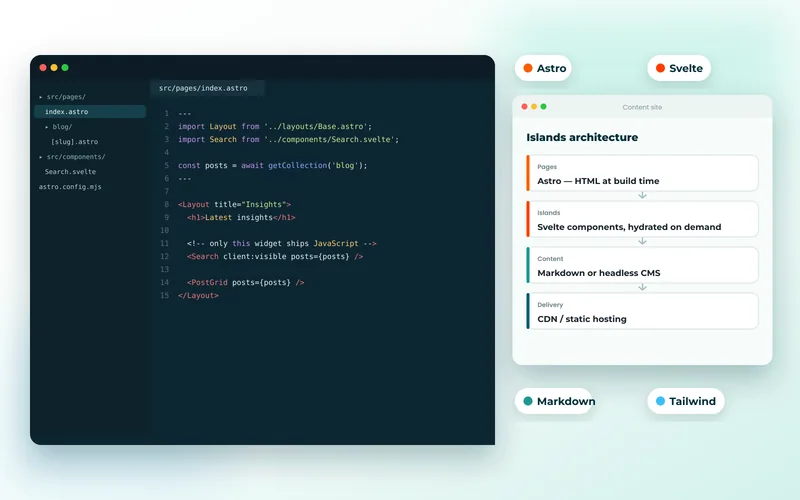
Astro takes the position that most of a page needs no JavaScript at all. It renders components to HTML at build time and ships nothing to the browser unless you explicitly ask. Interactive pieces — a search box, a carousel, a calculator — become "islands" that hydrate individually.
It is also framework-agnostic: an Astro site can host React, Svelte and Vue components side by side, which makes it unusually practical for teams with mixed skills or an existing component library.
Astro and Svelte development is our recommendation for content-led sites where load time is a commercial concern.
Where This Matters Commercially
Less JavaScript means faster interaction readiness, which is a Core Web Vitals measure and a conversion factor. It matters most on mid-range phones and slower connections, which is where a large share of real traffic sits — desktop testing consistently hides the problem.
Our guide to improving Core Web Vitals covers the measurement side, and this is the same problem addressed at the architecture level rather than by optimisation afterwards. It is a recurring theme in website speed optimisation.
The Honest Limitations
- Smaller ecosystems. Fewer ready-made components and integrations than React. You will occasionally build what you would have installed.
- Smaller hiring pool. Real, though both are approachable enough that a competent developer picks them up quickly.
- Astro is not for applications. A dashboard with complex shared state is not what it is for — that is React or Angular territory.
Choosing Between Them
They are complementary rather than competing. Astro is an architecture for content sites; Svelte is a component framework. Astro with Svelte islands is a common and effective pairing.
If the site is mostly content with some interactivity — marketing sites, documentation, blogs, brochure sites — start with Astro. If you are building an application, use Svelte with SvelteKit, or Next.js if you want the larger ecosystem. Our comparison of front-end frameworks covers the wider picture, and why Next.js became the default explains when the heavier option is justified.
Content Still Needs Managing
Neither is a CMS. Editors need somewhere to work, which usually means a headless CMS feeding the build. For a small site, Markdown files in the repository are a perfectly respectable answer that many teams dismiss too quickly.
And whichever you pick, the fundamentals still decide whether you rank — see the technical SEO checklist and our front-end development approach.
Tell us how content-heavy your site is and we will recommend the lightest architecture that does the job.