eCommerce
Keeping Subscribers When Payments Fail: Retries, Dunning, Pauses and SCA
Many lost subscribers never chose to leave: their card expired or a renewal needed authentication nobody asked for. Here is how we set up subscription billing to recover failed payments, with sensible retries, dunning emails people act on, card updates, SCA handling and pause and skip options.

When subscription businesses talk about churn they usually mean customers who decided to leave. A large share of lost subscribers never made that decision. Their card expired, their bank declined a renewal it thought looked unusual, or a payment needed one extra tap of authentication that nobody asked them for. The subscription lapsed quietly, and by the time anyone noticed, the customer had moved on.
This is the least glamorous part of our payment and subscription integration work and often the most valuable. The happy path, a card that renews every month, is easy. The money is lost in the failures.
Why Renewals Fail
Each kind of failure needs a different response, so it helps to separate them:
- Expired or replaced cards. The commonest cause. The customer still wants the subscription; their card number changed.
- Insufficient funds. Often temporary. A retry a few days later, after payday, frequently succeeds.
- Bank declines. The issuer's fraud checks block a charge. Some of these clear on a retry; others need the customer to contact their bank.
- Authentication required. In the UK and Europe, Strong Customer Authentication means the bank can ask the cardholder to confirm a payment, even a renewal.
- Hard declines. Lost, stolen or closed cards. Retrying these is pointless and can count against you with the card networks.
- Integration faults. A missed webhook, an expired API key or a plugin update that broke renewals. These fail silently for every subscriber at once, which is why monitoring matters.
Retries: Timing Beats Volume
Retrying a failed card every hour does not recover more payments. It annoys banks and customers. A sensible schedule spaces retries over one to two weeks, avoids retrying hard declines at all, and stops at a defined point. As an example, a monthly subscription might retry after three days, again after a further four, and a final time a week later, emailing the customer alongside each attempt.
The major subscription tools do much of this for you. Stripe Billing offers automatic retries timed by its own models; WooCommerce Subscriptions has a built-in retry system with configurable rules; Shopify's subscription apps handle retries through their own settings. Your job is to choose the rules, decide what happens to the order during the retry period, and decide what happens at the end.
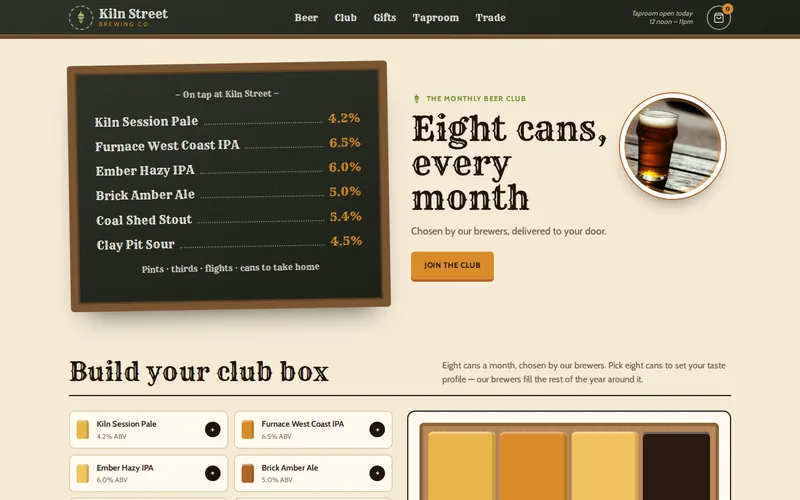
That middle question matters for physical products. On the craft brewery beer club we rebuilt on WooCommerce, renewals are charged through Stripe, and when a card fails the dunning flow retries and emails the member to update their details. Before, someone worked out who was due each month, took payments by hand through a payment link and chased failed cards by phone.
Dunning Emails People Act On
Dunning is the sequence of messages asking a customer to fix a failed payment. Most dunning emails fail because they read like threats or like spam. The ones that work share a few traits:
- A plain subject line that says what happened: "Your payment for this month's box did not go through".
- One clear action: a single link to update the card, which takes the customer to a secure page without forcing them to remember a password first.
- A clear consequence and date: what will happen and when if nothing changes, without drama.
- A human tone. Most recipients are not trying to avoid paying. Treat them as customers, not debtors.
- Reliable delivery. A dunning email in the spam folder recovers nothing. Send from an authenticated domain; our email deliverability service and our guide to why website emails land in spam cover how.
Fix Cards Before They Fail
The cheapest failed payment is the one that never happens:
- Expiry reminders. Email customers whose card expires before their next renewal, a couple of weeks ahead.
- Automatic card updates. Card networks run updater services that pass new card details to merchants when a card is reissued. Stripe and other large gateways use these automatically for many cards, which quietly prevents a share of failures.
- Self-service card changes. Customers should be able to change their card from their account in under a minute. On the brewery club, members change their card, pause for a month or skip a box from their account.
Strong Customer Authentication and Renewals
Under SCA rules in the UK and Europe, the first payment of a subscription is normally authenticated by the customer, which also sets up permission for future charges. Later renewals are merchant-initiated and usually go through without the customer being present. Usually, not always: the customer's bank can still ask for authentication on any charge.
When that happens, the renewal cannot succeed until the customer comes back and confirms it. Your system needs to recognise this specific failure, email the customer a link to a page where they can complete authentication, and not count it as an ordinary decline to be retried. We test this with the gateway's test cards before launch, because it is easy to build a flow that handles declines perfectly and leaves authentication requests hanging.
Pause and Skip: The Cheapest Retention Tool
Many cancellations are not about the product. The customer is going on holiday, has too much stock, or needs a cheaper month. Give them a pause or a skip and many will stay. On the brewery club, self-service pauses and skips cut cancellation requests, because people who simply needed a break no longer had to leave to get one. Our sports nutrition store on Shopify uses the same idea: customers manage deliveries in a portal, pausing before a holiday, skipping a month or changing flavour.
Offering a pause during cancellation is fair. Making cancellation hard is not, and in many places it is a legal risk as well as a reputational one. Cancelling should take about as long as signing up did.
What to Measure
- Failed payment rate per renewal cycle, split by decline reason.
- Recovery rate: the share of failed payments recovered within the retry window.
- Involuntary churn: subscribers lost to payment failure rather than cancellation.
- Pauses and skips versus cancellations.
- Renewals processed per day, with an alert if it suddenly drops to zero.
Whether you run subscriptions on WooCommerce, Shopify or a custom platform, these numbers tell you where money is leaking. If you do not know your recovery rate, tell us which platform and gateway you use and we will tell you where to find it, and what we would change first.
Frequently Asked Questions
What is dunning in subscription billing?
Dunning is the process of recovering a failed recurring payment: retrying the charge on a schedule and contacting the customer to update their payment details. A good dunning setup combines automatic retries timed to give temporary problems a chance to clear, a short sequence of clear emails with a one-click card update link, and a defined end point where the subscription pauses or ends.
How many times should a failed subscription payment be retried?
Typically three or four attempts spread over one to three weeks, depending on your billing cycle. Weekly subscriptions need a shorter window than monthly or annual ones. Hard declines such as lost or stolen cards should not be retried at all, and payments that need customer authentication should trigger an email rather than a blind retry. Gateways such as Stripe can time retries automatically.
Do subscription renewals need Strong Customer Authentication?
Usually not every time. The first payment is normally authenticated, and later renewals are treated as merchant-initiated transactions that can go through without the customer present. However, the customer's bank can still request authentication on any renewal. Your billing system must detect that response and send the customer a link to confirm the payment, rather than treating it as a decline.
Should we stop shipping while a payment is being retried?
For physical products, generally yes. Holding the box until the renewal succeeds avoids sending goods you may never be paid for, and most customers fix their card within days when the emails are clear. For digital access, many businesses keep the service running during a short grace period, because cutting access immediately loses customers who would have paid.
Can we switch payment gateways without losing subscribers?
In most cases, yes. Major gateways support secure migration of saved payment methods between providers, so customers do not need to re-enter cards. The migration needs planning around renewal dates, mapping of subscriptions in your store, and testing before the switch. Done carelessly, it can cause a wave of failed renewals or double charges, so it is worth treating as a project in its own right.