Cloud, Data & AI
Adding AI to Your Website: Use Cases That Actually Pay Off
Most AI website projects fail because they start from the technology. These start from a measurable business problem — and that is why they work.
There is a lot of pressure to "add AI" to websites, and a lot of money wasted doing it. The projects that succeed have one thing in common: they started from a task that was already costing time or losing revenue, not from a desire to use the technology.
1. A Support Assistant That Knows Your Business
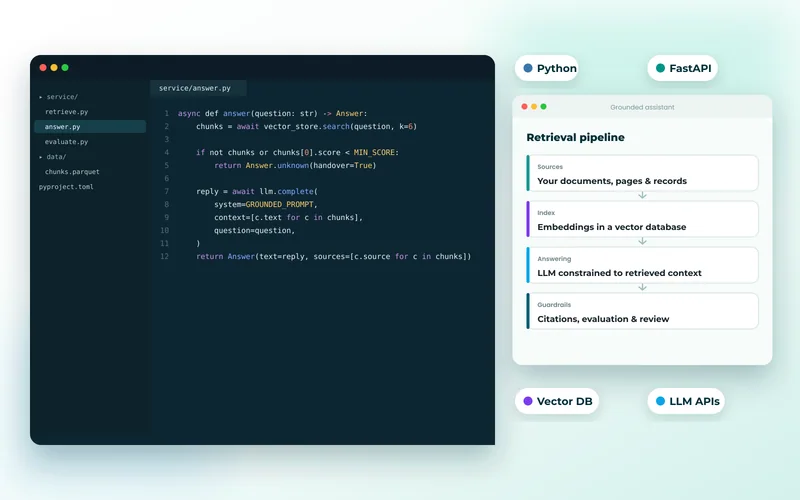
Generic chatbots frustrate people. An assistant grounded in your own documentation, product data and past support tickets is a different proposition — it can answer specific questions about your products, policies and pricing, and hand over cleanly when it cannot.
The engineering that matters here is retrieval: finding the right information from your content before answering, so responses are based on facts rather than invention. We built a software support AI assistant on exactly this pattern, and it is the approach we use in AI integration development.
2. Search That Understands Intent
Keyword search fails when customers describe what they want in their own words rather than yours. Semantic search matches meaning, so "something warm for hiking in winter" can surface the right jacket without those exact words appearing in the product title.
For large catalogues this often produces a measurable conversion improvement, and it is usually a smaller project than a full assistant. It pairs naturally with eCommerce development work.
3. Document and Data Processing
This is the least glamorous category and frequently the most profitable. Extracting structured data from invoices, forms, contracts or delivery notes removes hours of manual entry and the errors that come with it.
We automated invoice processing with OCR for a client whose team was rekeying documents by hand. The return was obvious within weeks, because the cost being removed was already visible on a payroll.
4. Content Workflows
Drafting product descriptions from specifications, generating alt text for large image libraries, summarising long documents, translating content into other markets — these are assistive tasks with a human reviewing the output, which is where current models are genuinely reliable.
What to Be Careful About
- Hallucination. A model asked a question outside its knowledge will often answer confidently and wrongly. Ground responses in your own data and make "I don't know" an acceptable answer.
- Running cost. API calls are charged per use. A feature on every page view has a very different cost profile from one used occasionally — model this before launch, not after.
- Data protection. Understand where data goes and whether it is retained. For sensitive material this may rule out certain providers entirely.
- Latency. Model calls take seconds. Design the interface for that, and never block a page render on one.
Where the Work Actually Is
The model is rarely the hard part. Most of the effort goes into getting your data into a usable shape, building the retrieval layer, handling failure gracefully and integrating with what you already run. In other words it is ordinary custom web development, database and integration work with a model at one end.
It also needs somewhere reliable to run, with sensible scaling and cost controls — part of cloud and DevOps services.
Start Small and Measure
Pick one task with a number attached: hours spent, tickets received, conversion rate. Build the smallest version that addresses it, measure honestly, and expand only if the number moves. Projects that begin with "we should use AI" and search for a use case afterwards are the ones that quietly get switched off.
Tell us which task is costing you time and we will tell you whether AI is the right tool for it — including when a simpler piece of automation would do the same job for less.