Frameworks & Languages
CodeIgniter in 2026: Upgrade, Maintain, or Migrate to Laravel?
Plenty of business applications still run on CodeIgniter, and most of them are fine. Here is how to decide whether yours needs an upgrade, a maintainer, or a planned move to Laravel.
CodeIgniter was the framework a whole generation of PHP developers reached for between about 2008 and 2016. It was small, fast and easy to learn, and it powered a great many order desks, member portals, booking systems and internal tools that are still in use today. If you own one of them, the question is rarely "is CodeIgniter bad?" — it is "what should we do with this application now?"
Why the Question Comes Up
Three things usually force it. The hosting company retires an old PHP version, and the application throws errors on the new one. The original developer is no longer available and nobody else wants to touch the code. Or the business needs a feature that the application, as built, cannot easily accommodate.
None of these means the application must be rewritten. Our CodeIgniter development service exists precisely because most of these applications are worth keeping, at least for now.
Option 1: Upgrade in Place
If the application does its job and mainly needs to keep running, the right move is an upgrade: bring it onto CodeIgniter 3 or 4 and a supported PHP 8 release. The work is mostly mechanical but not trivial. PHP 8 removed functions, changed how errors are raised and tightened type handling, and a CodeIgniter 2 codebase will trip on dozens or hundreds of these.
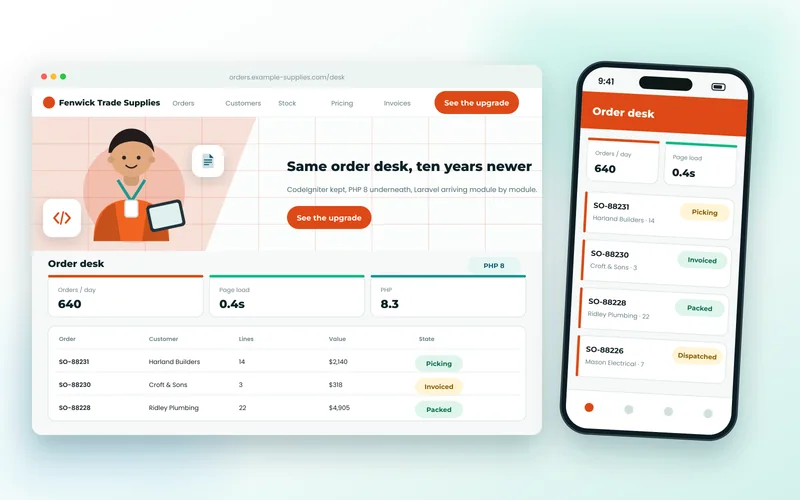
The trick is doing it on a copy against real data, screen by screen, with tests around anything that calculates money. When we upgraded a trade supplier's order desk we fixed 340 incompatibilities this way, three weeks before the host's deadline, and the staff never noticed a change.
Option 2: Maintain and Improve
Many CodeIgniter applications are slow not because of the framework but because of what was built on it: missing database indexes, queries inside loops, reports that load everything to display a week. These are the same problems we fix in Laravel and PHP applications, and they respond to the same treatment.
A maintenance arrangement — updates, monitoring, small changes and a known person to call — often extends the useful life of an application by years for a fraction of a rebuild's cost. Our maintenance plans cover CodeIgniter applications as readily as WordPress sites.
Option 3: Migrate to Laravel
Laravel is where the PHP ecosystem's energy went. It has a far larger library of packages, better tooling for testing and queues, and it is much easier to hire for. If your roadmap has real new features on it, migrating is usually right.
The mistake is doing it as a big-bang rewrite. Rewrites take longer than planned, freeze the business while they happen, and tend to reproduce old bugs alongside new ones. We migrate module by module instead: Laravel runs alongside CodeIgniter, sharing the database and session, and each area is rebuilt and switched over behind the same URLs. The application never stops working, and the business gets the most valuable modules first.
Do Not Skip the Security Review
Whichever route you take, an application written in 2012 was written against 2012's threats. Password hashing, file uploads, SQL construction and session handling all need checking. A security audit before or during an upgrade is cheap insurance, particularly if the application holds customer data.
A Simple Decision Rule
- Stable, few changes planned: upgrade in place, then maintain.
- Slow or fragile, but the right shape: upgrade, then fix performance and add tests.
- Roadmap of new features: upgrade first so it is safe, then migrate to Laravel in stages.
If you are weighing this up, send us the details — how old the application is, what it does and what is prompting the question. We review the code before quoting, so the estimate reflects what is actually there. For a broader comparison of where it might end up, see our note on Laravel for business applications.