Frameworks & Languages
Laravel for Business Applications: What You Get Out of the Box
Laravel ships with the parts every business application needs anyway — auth, queues, scheduling, permissions. That is why it delivers so quickly.
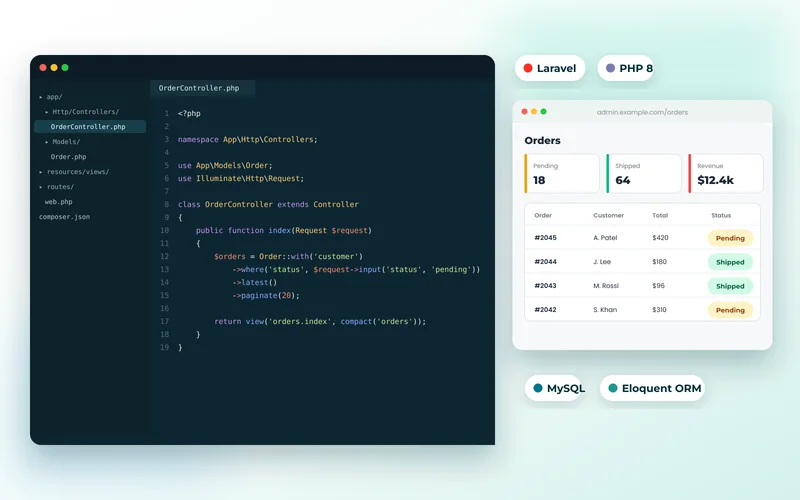
Most internal business systems need the same foundations: users and roles, a database layer, background jobs, scheduled tasks, file handling, email, and an admin interface. The difference between frameworks is how much of that you build yourself. Laravel's answer is "almost none of it", which is why it remains our most frequent recommendation for custom business software.
What Ships With It
- Authentication and authorisation — login, password resets, email verification, and a permissions system based on policies rather than scattered checks.
- Eloquent ORM — readable database access with relationships, plus migrations that version your schema alongside your code.
- Queues — move slow work such as PDF generation, imports and emails off the request so pages stay fast.
- Task scheduling — recurring jobs defined in code rather than scattered across crontabs.
- Validation, testing and logging as first-class concerns rather than add-ons.
None of this is exotic. The value is that it is consistent, documented and maintained, so a new developer can read the codebase. That is the real argument for Laravel development on systems that must outlive the team that built them.
Where It Fits Best
Laravel suits the enormous middle ground of business software: quoting systems, portals, booking platforms, internal tools, approval workflows and anything where the domain logic matters more than the technology.
We built a field service quoting platform and a property management tenant portal on this basis — both have many roles, many forms and a lot of business rules, which is exactly the shape Laravel handles well.
The PHP Question
PHP's reputation lags a decade behind reality. Modern PHP has proper types, is genuinely fast, and runs everywhere cheaply. The performance difference against Node or Python for typical business workloads is not what decides projects; hosting cost, hiring and delivery speed are, and PHP wins on all three.
It also matters that PHP hosting is universal. A Laravel application can be deployed almost anywhere, which lowers both cost and risk compared with stacks needing specialised infrastructure.
Working Alongside WordPress
Many businesses have a WordPress site and need an application that is not a good fit for it — a customer portal, a calculator, a booking engine. Building that in Laravel and linking the two is usually far cleaner than forcing it into WordPress with plugins.
The two coexist comfortably: keep WordPress for marketing content where editors are productive, and put the application logic in Laravel. Our post on custom builds versus WordPress works through where that line sits.
When to Choose Something Else
Pick Node.js if the product is real-time at its core. Pick Python if data processing or machine learning is central. Pick .NET or Java for large regulated systems with many developers. We compare these directly in choosing a backend stack.
Where Projects Go Wrong
Laravel makes it easy to write code quickly, including bad code. The failures we are called in to fix are almost always the same: business logic buried in controllers, no tests, and database queries that were never examined under real data. That last one is the most expensive, and we cover it in why sites slow down as they grow and address it through database development.
Describe the process you want to systematise and we will scope it honestly — including telling you when an off-the-shelf product would serve you better than anything custom.