Frameworks & Languages
Node.js vs Laravel vs Django vs .NET: Choosing a Backend Stack
Your backend choice affects hosting costs, hiring and how fast you can ship for years. We compare the four most common options on the criteria that actually matter.
A backend choice is a long commitment. Frontends get rewritten every few years; the backend usually outlives them, along with its database schema, deployment pipeline and the team that knows it. Here is how the main options differ in practice.
Node.js
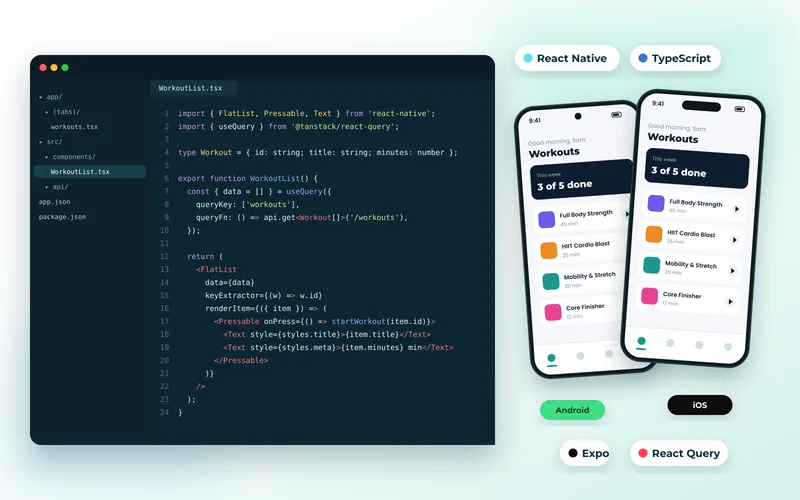
Node runs JavaScript on the server, which means one language across the whole stack. That is a real organisational advantage: the same developers move between frontend and backend, and types can be shared end to end with TypeScript. Its non-blocking model handles many concurrent connections efficiently, making it strong for APIs, real-time features and streaming.
Where it demands discipline is structure — Node imposes very little, so conventions must come from your team. Node.js development is our usual pick for real-time and API-first products, such as a freight dispatch and driver tracking platform where live position updates were the core of the product.
Laravel (PHP)
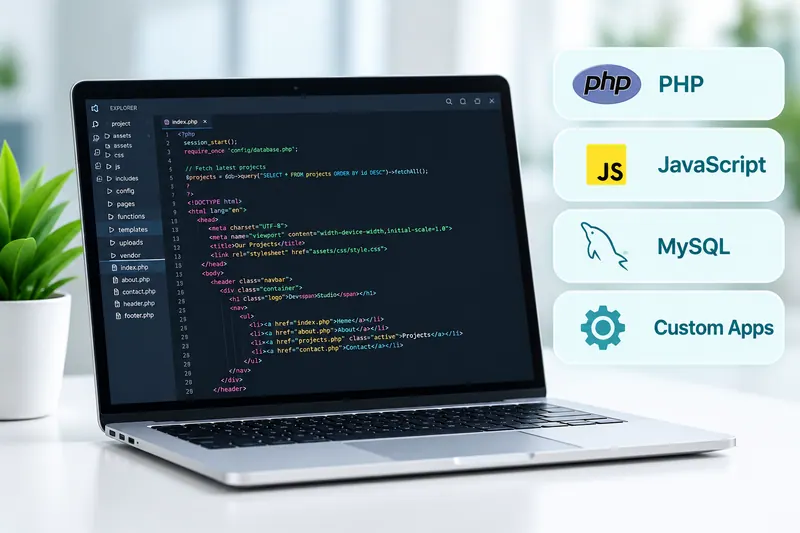
Laravel turned PHP into a genuinely pleasant modern framework. Its conventions cover routing, database access, queues, scheduling, authentication and testing, so a competent team can build a substantial application quickly. Hosting is cheap and available everywhere, and the hiring pool is deep.
For most business applications, Laravel development offers the best ratio of delivery speed to running cost. It also integrates comfortably with existing WordPress or WooCommerce estates, which matters when you are extending rather than replacing.
Django and FastAPI (Python)
Python's advantage is everything around it. If your product involves data processing, machine learning or scientific computation, the libraries you need already exist in Python and nowhere else. Django brings an admin interface, ORM and authentication out of the box; FastAPI is the leaner, modern choice for APIs.
Python development is the obvious answer when the application is data-heavy — for example invoice processing with OCR automation, where the document pipeline mattered more than the web layer.
.NET and Java
Both are built for large, long-lived systems. Strong typing, mature tooling and excellent performance make them the default in finance, healthcare and enterprise integration, where a codebase may run for fifteen years and auditability is not optional.
.NET development and Java with Spring Boot carry more upfront ceremony than Laravel or Django, and they repay it on systems with many developers and a long horizon.
The Others Worth Knowing
Ruby on Rails remains outstanding for rapid product development and is still the fastest route from idea to working application for many teams. Go, Rust and Elixir serve more specific needs: Go for efficient services and tooling, Rust where performance and memory safety are critical, Elixir for massive concurrency.
Choosing Without Regret
- Data or AI work? Python, almost regardless of other factors.
- Real-time or API-first? Node.js.
- Standard business application, tight budget? Laravel.
- Enterprise, regulated, long-lived? .NET or Java.
Whatever you choose, the database schema deserves more attention than the framework does. Most performance problems we are called in to fix turn out to be missing indexes and query patterns, not language choice — a recurring theme in our database development work.
Not sure which fits? Tell us what the system has to do and we will recommend a stack, including the option of keeping the one you already have. You may also want to read our comparison of custom builds and WordPress if you are still deciding how much to build from scratch.