eCommerce
Headless Commerce: When Decoupling Your Storefront Pays Off
Headless commerce promises speed and freedom, and charges for it in complexity. Here is how to judge whether your store is one of the ones that benefits.
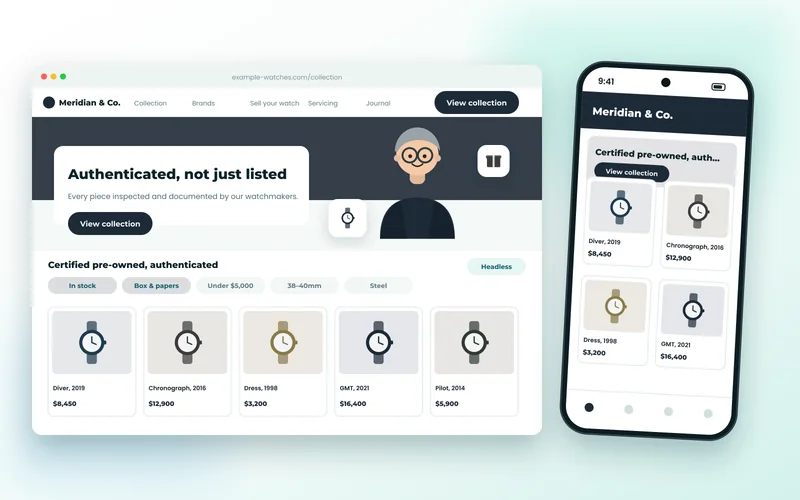
In a headless commerce build, the platform keeps doing what it is good at — products, carts, checkout, payments, tax — while the storefront becomes a separate application that talks to it over an API. You gain control over the customer-facing experience and take on the responsibility of building it.
What You Gain
Performance You Control
A custom storefront can be pre-rendered and served from a CDN, with product data fetched as needed. You are no longer subject to a theme's script loading or an app that injects render-blocking JavaScript into every page. For large catalogues this is often the single biggest gain, and it feeds directly into Core Web Vitals.
Experiences a Theme Cannot Express
Configurators, guided selling, complex bundling, membership pricing, interactive lookbooks — these are awkward or impossible inside a standard theme and natural in a custom front end. We built a luxury watch headless storefront because the brand needed an editorial experience that no theme could deliver while keeping Shopify's checkout.
Several Channels, One Backend
Website, mobile app, in-store kiosk and marketplace feeds can all read from the same commerce API, which is the same argument that drives headless CMS adoption on the content side. Many headless commerce builds combine both: a commerce API for products and orders, a content API for editorial.
What It Costs
- The theme editor goes away. Merchandisers lose drag-and-drop control unless you rebuild it, which is real work.
- Apps may stop working. Many rely on injecting scripts into a standard theme. In a headless build each one needs its own integration.
- More infrastructure. The storefront is a deployed application needing hosting, monitoring and a release process — in other words, ongoing cloud and DevOps support.
- SEO becomes your responsibility. Metadata, structured data, canonical tags and sitemaps are all yours to implement correctly.
Who Should Not Go Headless
If your store sells a few hundred products through a well-built theme, converts acceptably and is maintained by a small team, headless will cost more and return little. The honest advice for most stores is to invest in speed optimisation and conversion work on the existing platform first. Those improvements are cheaper, faster and often produce the result people hoped headless would deliver.
Who Should
Consider it when the storefront experience is a genuine competitive differentiator, when you are serving several channels from one catalogue, when your catalogue is large enough that theme rendering is a measurable constraint, or when you have the in-house capability to maintain a front-end application. Typically that means a Next.js or React storefront over Shopify or BigCommerce.
A Middle Path
You do not have to decouple everything. Many stores get most of the benefit by keeping a standard theme for product and checkout pages while building custom experiences only where they matter — a configurator, a landing page family, a members' area. This keeps the merchandising tools intact and limits the surface you maintain. Our eCommerce development engagements often start here precisely because it de-risks the decision.
Tell us your platform, catalogue size and what the current theme stops you doing, and we will tell you honestly whether headless is worth it for you — including when it is not.