eCommerce
Magento to Shopify Migration: What to Plan Before You Move
Replatforming an established store is mostly a data and SEO exercise, not a design one. Here is the sequence that protects your rankings and your revenue.
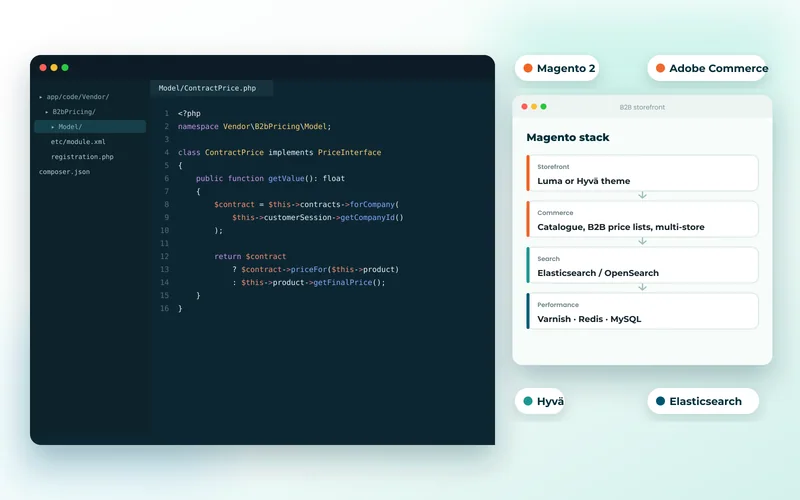
Stores leave Magento for predictable reasons: hosting and maintenance costs, the size of the upgrade treadmill, and the difficulty of finding developers. Shopify removes most of that operational burden. The migration itself, though, is where stores lose rankings and revenue if it is rushed.
Decide What Actually Moves
A replatform is a rare chance to leave things behind. Before exporting anything, audit what you have: products that have not sold in two years, categories nobody browses, customer accounts that never ordered. Moving less means a faster, cleaner store.
What must move is usually products with their variants and images, customers with their addresses, order history for service purposes, and your content pages. Note that historical orders are reference data on the new platform — they do not become fulfillable orders.
Protect the URLs First
This is the step that decides whether traffic survives. Magento and Shopify structure URLs differently: Shopify enforces prefixes such as /products/ and /collections/, so almost every URL changes.
Export every indexed URL before you start — from your sitemap, from analytics, and from Search Console — then map each one to its destination and implement 301 redirects at launch. Unmapped URLs become 404s, and the rankings they held disappear with them. We treat this mapping as a deliverable in its own right during technical SEO optimisation.
Rebuild Rather Than Replicate
Trying to reproduce a Magento theme pixel-for-pixel in Shopify fights the platform. Shopify's sections and blocks work differently, and a faithful copy usually means fragile custom code that breaks on the next theme update.
A better approach is to keep your brand, navigation logic and proven conversion elements, and rebuild them the Shopify way with Shopify development and properly structured Liquid sections. Merchandising teams get editable layouts instead of hard-coded templates.
Integrations Are the Hidden Cost
Most Magento stores have accumulated integrations: ERP, accounting, shipping, PIM, marketplace feeds, subscription billing. Each one needs a replacement app, a rebuilt connection, or a middleware layer.
List them all early and check each against the Shopify app ecosystem. Where nothing fits, a custom connector built through API development and integration is usually cheaper than changing your back-office processes. We did exactly that for a wholesaler's ERP and webshop integration.
Is Shopify Definitely Right?
Not always. If your catalogue relies on complex B2B pricing rules, multi-warehouse inventory logic or deep customisation, staying on Magento or moving to BigCommerce may serve you better. Stores tightly coupled to WordPress content sometimes do best consolidating on WooCommerce.
Our post comparing Shopify, WooCommerce and BigCommerce goes through those trade-offs. For a furniture retailer we handled exactly this decision before replatforming them from Magento to Shopify.
A Launch Sequence That Works
- Build and populate the new store on a password-protected domain.
- Import data, then verify counts and spot-check products against the old store.
- Load the redirect map and test a sample of the highest-traffic URLs.
- Reconnect payments, tax and shipping, then place real test orders end to end.
- Switch DNS at a genuinely quiet hour, then monitor 404s and Search Console daily for a fortnight.
Expect a temporary ranking dip in the weeks after launch even when everything is done correctly. What matters is that it recovers, which it does when redirects are complete and the new pages are fast.
Planning a move? Send us your current platform and catalogue size and we will outline the realistic scope, sequence and risks before you commit.