Frameworks & Languages
Nuxt for Content-Heavy Sites: Vue With the Hard Parts Solved
Nuxt does for Vue what Next.js does for React — rendering, routing and SEO handled — with a gentler learning curve that suits mixed teams.
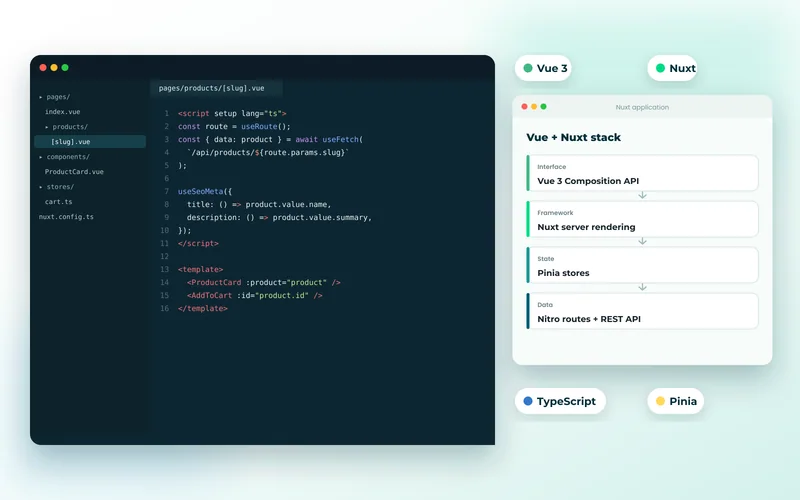
Vue has always been the most approachable of the major front-end frameworks. Its templates look like HTML, its reactivity is easy to reason about, and developers coming from a server-rendered background pick it up quickly. Nuxt takes that and adds everything a public website needs.
What Nuxt Provides
- Server rendering and static generation, so content is in the HTML for crawlers and slow devices.
- File-based routing — the pages directory is the URL structure.
- Automatic component imports, removing a great deal of boilerplate.
- Data fetching helpers that work correctly on both server and client, which is where hand-rolled setups usually break.
- Built-in SEO handling for titles, meta tags and structured data per route.
In short, Nuxt and Vue development gives you the same completeness Next.js gives React, with less ceremony.
Why It Suits Content Sites
Content-heavy sites have a particular shape: many pages, mostly static, with pockets of interactivity — a filter, a calculator, a booking widget. Nuxt handles that split well. Pages can be pre-rendered at build time and served from a CDN, while interactive components hydrate where needed.
Its hybrid rendering lets you choose per route: static for articles, server-rendered for anything personalised, client-only for a dashboard behind a login. Getting this right is most of the performance story, and it feeds directly into the Core Web Vitals we discuss in improving Core Web Vitals.
Pairing It With a CMS
Nuxt is a front end; your editors still need somewhere to write. The usual pattern is a headless CMS feeding Nuxt over an API, which keeps the editing experience familiar while the site itself stays fast. The trade-offs of that architecture are covered in headless vs traditional CMS.
It is worth being clear-eyed: if your editors rely on drag-and-drop layout control and nobody needs the performance ceiling, a well-built WordPress site may serve you better for less money.
Nuxt or Next.js?
Technically they are close enough that either will do the job. The decision is about people. If your team knows Vue, Nuxt. If they know React, Next.js. If they know neither, React has the larger hiring pool, which is a legitimate commercial consideration.
Vue's separation of template, script and style in single-file components is frequently easier for designers and less experienced developers to work in, which matters on teams where not everyone is a specialist. We compare the field in choosing a front-end framework.
What to Watch
Two things catch teams out. First, hydration mismatches — content rendered differently on server and client produces subtle bugs, and dates, randomness and browser-only APIs are the usual culprits. Second, over-fetching: it is easy to request more data than a page needs when the framework makes fetching effortless, which shifts the cost to your database.
And as always, server rendering makes a site crawlable but does not make it rank. The items in our technical SEO checklist still apply.
Tell us about your content and who maintains it, and we will recommend the right combination — including the simpler option where it fits. You can also see our front-end development work.