Frameworks & Languages
Angular for Large Applications: When Structure Beats Flexibility
Angular makes more decisions for you than any other major framework. On a big, long-lived application maintained by a rotating team, that is the feature.
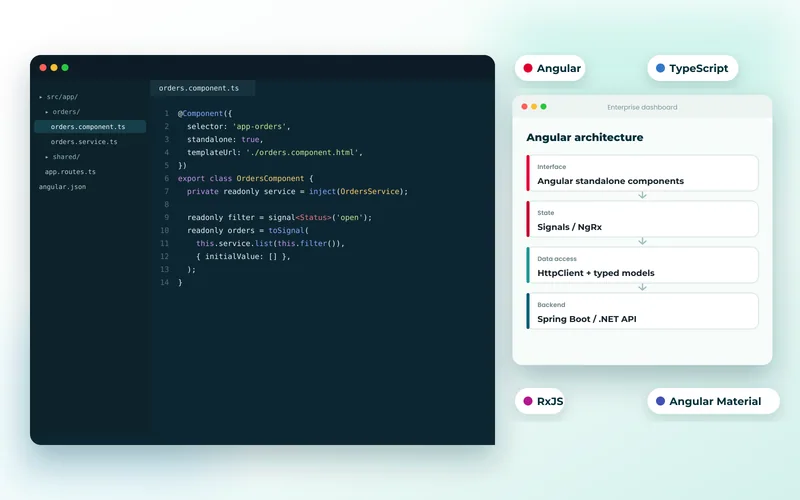
Angular is regularly dismissed as heavy or dated. That judgement usually comes from applying it to the wrong kind of project. On a large internal application with many developers and a long life ahead of it, the things people criticise turn out to be the things that keep it maintainable.
Everything Is Included
Routing, HTTP, forms, validation, internationalisation, testing and dependency injection all ship as part of the framework, maintained together and versioned together. There is no debate about which router or state library to adopt, and no risk that the community's favourite is abandoned in two years.
On a project spanning several years and several teams, that consistency compounds. A developer moving between two Angular codebases finds the same patterns; two React codebases can look like different languages. This is the core argument for Angular development on enterprise work.
TypeScript Throughout
Angular was built for TypeScript rather than adding it later, and it shows in the tooling. Templates are type-checked against their components, so a renamed property produces a build error instead of a blank space on a page. Refactoring a large codebase becomes something you can do with confidence.
Where It Genuinely Fits
Admin panels, claims systems, dashboards, back-office tools, anything with a great many forms — Angular's reactive forms are the strongest form handling in any mainstream framework, and enterprise applications are mostly forms.
We chose it for an insurance claims administration portal precisely for that reason: many roles, many validation rules, and a system expected to be maintained for years by people who had not written it.
Where It Is the Wrong Choice
A marketing site, a small interactive feature, or a public page where every kilobyte counts. Angular's bundle is larger than a Svelte or Astro equivalent, and its structure is overhead on a small project.
For content-led sites, Astro or Svelte will produce something faster with less code, and Next.js or Nuxt sit sensibly in between. We compare them all in choosing a front-end framework.
The Learning Curve Is Real
Angular asks you to understand modules or standalone components, dependency injection, RxJS observables and its change detection model before you are truly productive. That is a genuine cost, and it is why small teams often prefer React.
It is repaid on large codebases, where the same concepts make complex data flows tractable. RxJS in particular is awkward to learn and extremely effective once understood, especially for coordinating multiple asynchronous sources.
What It Pairs With
Angular front ends most commonly sit on .NET or Spring Boot backends, because the same organisations tend to value the same things. The contract between them is the API, and getting that right matters more than either framework choice.
If the application is public-facing rather than behind a login, remember that a client-rendered Angular app is not crawlable by default — Angular Universal handles server rendering, and the rest of the technical SEO checklist still applies.
Tell us how large the application is and who will maintain it, and we will recommend a framework on that basis rather than on fashion.