eCommerce
Selling Repeat-Purchase Products on BigCommerce: Bundles, Subscriptions and Reorders
For pet food, supplements and anything else customers run out of, the second order is where the margin is. Here is how we set up BigCommerce stores for repeat purchase: product options that map to real SKUs, subscribe-and-save people choose, sensible bundles and reorder flows for customers who will never subscribe.
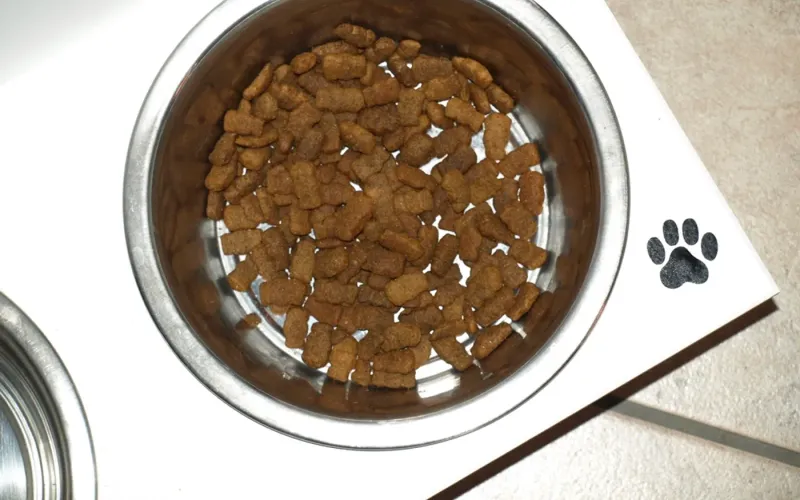
Some products are bought once. Dog food, supplements, coffee, contact lenses and cleaning products are bought again and again, on a schedule set by how fast they run out. For those stores the first order is the expensive one: you paid to acquire the customer. Every order after it is where the margin lives, and the moment you lose it is the moment the bag runs empty and the customer buys whatever the nearest shop has.
We build stores like this through our BigCommerce development service. BigCommerce suits them well: a strong native catalogue, fast faceted search and a hosted checkout. But repeat purchase does not happen by itself. It has to be designed into the product data, the product page, the customer account and the emails.
Model the Product Before the Subscription
Most repeat-purchase problems we untangle start with product data that was set up for a one-off shop. BigCommerce gives you two kinds of product option, and the difference matters:
- Variant options such as bag size or flavour create real variants, each with its own SKU, price and stock level. Anything a customer reorders by name, like "the 12 kg salmon recipe", should be a variant, so the reorder points at an exact SKU.
- Modifier options such as a gift note or an engraving add information to the order line without creating stock. They are the wrong place for anything you need to count.
- Custom fields hold structured information that sits alongside the product, such as ingredients, analytical constituents and feeding guidance.
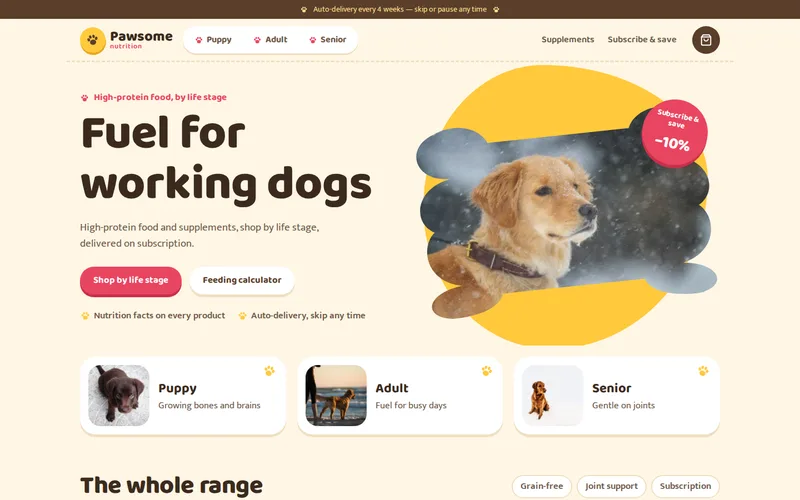
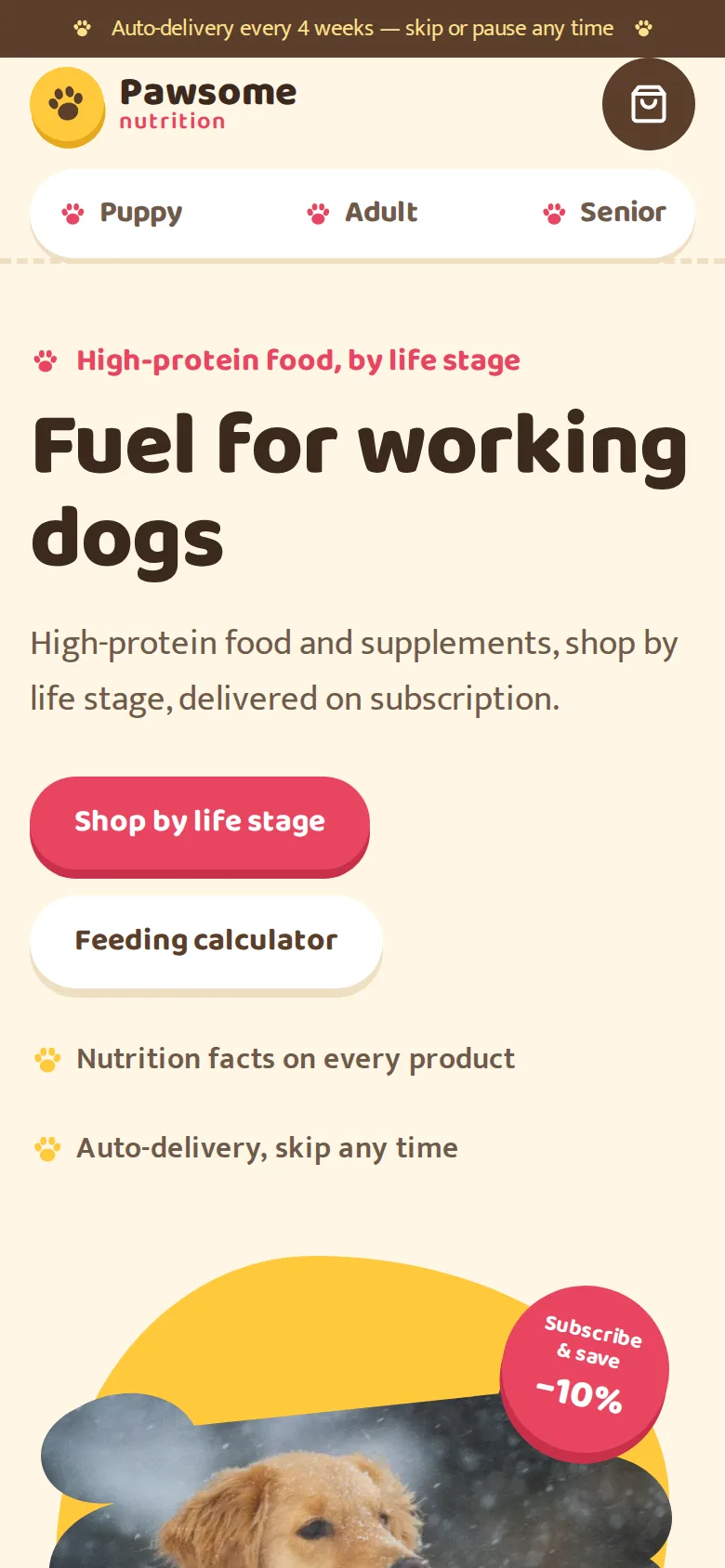
On the dog food and supplements store we built on BigCommerce, ingredients, nutrition and feeding guidance are stored in custom fields rather than typed into descriptions, so every product page shares one clear layout. That consistency is not only cosmetic. Owners who are about to commit to a food every few weeks read the label carefully, and structured data lets them compare like with like.
Subscribe-and-Save That People Actually Choose
BigCommerce relies on a subscription app or integration for recurring orders rather than a built-in subscription feature, so the first decision is which one, and the second is how it appears on the page. The details that decide whether people subscribe are small:
- Offer frequencies that match the pack. If a bag lasts roughly a month for a typical dog, offer three, four and six weeks, not "every 30 days" as the only choice.
- Show the saving in money, next to the one-off price, rather than as a percentage the customer has to work out.
- Make the commitment visibly small. Say plainly that deliveries can be skipped, moved or cancelled from the account.
- Keep management self-service. On the dog food store, customers choose a delivery frequency when they buy and then change the date, change the frequency or skip a delivery from their account without contacting support.
Self-service matters more than the discount. A customer who goes on holiday and cannot skip a delivery cancels instead, and a cancelled subscriber rarely restarts.
Bundles That Follow How Products Are Used
Repeat-purchase ranges usually have a main product and a set of companions. On the dog food store, supplements are recommended alongside the foods they complement: joint support with senior foods, probiotics and protein supplements with active and working-dog foods. Related products and bundles are configured with BigCommerce's native tools, so the team can adjust pairings without development work.
A few things to settle before building bundles:
- Stock: a bundle should draw down the stock of its components, or you will sell a bundle whose supplement is out of stock.
- Subscriptions: check whether your subscription app can put a bundle on a recurring schedule, and what happens when one component is discontinued.
- Discount stacking: decide in advance whether a subscription saving and a bundle saving combine. Customers will find out either way.
Reorder Flows for Customers Who Will Not Subscribe
Plenty of loyal customers never subscribe. They want control, or they buy at irregular intervals. They still need the store to make the second order easy:
- Reorder from the account. A visible "order again" route from order history that rebuilds the basket with the same variants.
- Replenishment reminders timed to pack size. A reminder that arrives a few days before a typical bag runs out is a service; one that arrives a week after it ran out is too late.
- Saved addresses and payment methods, so the second checkout takes a minute.
- Subscription offered after the second order, when the customer has shown they will buy again, rather than pushed at a first-time visitor.
All of these depend on email arriving. Order confirmations and reminders sent from a poorly configured domain land in spam, which is why we check sending setup with our email deliverability service as part of any repeat-purchase project.
Questions to Ask Before Choosing a Subscription App
The app becomes part of your business, holding your customers' schedules and, through your payment provider, their saved cards. Ask:
- Does it use the BigCommerce checkout, or send customers to a separate one?
- How does it handle failed renewals, expired cards and card updates?
- Can customers manage everything from their account on your store?
- Does it support variants, bundles and the discount rules you plan to use?
- How many scripts does it add to the storefront, and on which pages?
- If you leave, can you export subscribers and their schedules, and can the saved payment methods move with them?
The last question is the one most often skipped. Moving subscriptions between systems without customers re-entering cards is possible with most major gateways, but it needs planning. Our payment and subscription integration work covers that, along with the retry and dunning logic that keeps renewals from quietly failing.
What to Measure
- Repeat purchase rate: the share of first-time customers who place a second order, and how long it takes.
- Subscription share of orders, and how it changes after product page changes.
- Skips versus cancellations. A healthy subscription programme sees far more skips than cancellations.
- Attach rate of companion products such as supplements.
The same principles apply on other platforms. Our sports nutrition store on Shopify made subscribe-and-save the default choice on product pages, and the subscription share of orders grew substantially afterwards. If you are still deciding on a platform, our comparison of Shopify, WooCommerce and BigCommerce is a good place to start.
If you sell something people run out of, tell us what your repeat purchase rate looks like today and how your products are set up. We can usually point to the two or three changes that would move it most.
Frequently Asked Questions
Does BigCommerce have built-in subscriptions?
Recurring orders on BigCommerce are normally handled by a subscription app or a custom integration with your payment provider rather than a core platform feature. That gives you a choice of approaches, but it also means the app needs to be chosen carefully: how it handles checkout, failed payments, customer self-service and data export matters more than its feature list.
Should pack sizes be variants or separate products?
In most cases variants. A food sold in 2 kg, 6 kg and 12 kg bags is one product to the customer, and keeping the sizes as variants means reviews, content and search all live on one page while each size still has its own SKU, price and stock. Separate products make sense only when sizes differ in more than size, for example a trade pack sold to a different customer group.
How big should a subscribe-and-save discount be?
Large enough to be worth choosing and small enough that you still make money on every renewal after your payment and fulfilment costs. Many brands land somewhere between five and fifteen percent, but the right figure depends on your margins. The discount matters less than presentation: show it in money next to the one-off price and make it clear deliveries can be skipped or cancelled.
Can we move existing subscribers to BigCommerce from another platform?
Usually yes, but it needs careful planning. Subscribers, schedules and next delivery dates have to be imported into the new subscription system, and saved payment methods have to be transferred through the payment provider so customers do not re-enter their cards. We plan the cut-over around delivery dates so nobody misses an order or gets charged twice.
What is the quickest win for a store with low repeat purchases?
Look at what happens after the first order. Often there is no reminder when the product is due to run out, no easy reorder route in the account, and subscription is hidden below the add-to-basket button. A replenishment email timed to pack size and a visible order-again option can be in place within weeks, without changing platform or app.