Frameworks & Languages
Spring Boot for Enterprise Integration: Why Java Still Wins
When a system has to talk to a dozen others and keep running for a decade, Java and Spring Boot remain hard to beat. Here is why.
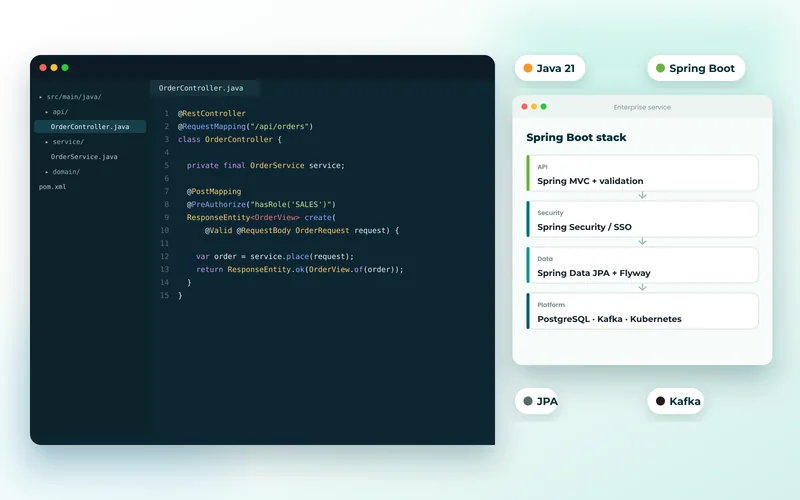
Java is not fashionable, and that is largely the point. Systems that must run for fifteen years, integrate with everything in the building and be maintained by people who have not met the original authors are exactly what the JVM ecosystem was built for.
Integration Is the Real Strength
Enterprise work is rarely about a single application. It is about a system that must exchange data with an ERP, a warehouse, a payment provider, a CRM and two legacy databases — reliably, transactionally, and with an audit trail.
Java has mature, battle-tested connectors for essentially every enterprise system in existence, plus first-class support for message brokers such as Kafka and RabbitMQ. When something goes wrong at three in the morning, the tooling to find out why is exceptional.
That is why Java and Spring Boot development is our recommendation when integration count is high — as with a wholesaler's ERP and webshop integration, where the web layer was the small part and keeping stock, pricing and orders consistent across systems was the project.
What Spring Boot Changed
Older Java frameworks earned their reputation for XML configuration and ceremony. Spring Boot replaced most of it with sensible defaults: an embedded server, auto-configuration, and production features such as health checks and metrics built in. A service can be running in minutes.
The result is a framework that keeps Java's rigour while removing most of what made it tedious.
Operating It
The JVM's real advantage appears in production. Memory profiling, thread analysis, heap dumps and flight recording are mature and standard, so diagnosing a problem in a running system is a routine exercise rather than an archaeology project. For systems that must not be taken offline to investigate, that matters more than raw benchmark numbers.
The cost is memory: JVM services want more of it than PHP or Go equivalents, and start more slowly. On long-running services neither matters much; for functions that scale to zero, both do. Right-sizing that infrastructure is cloud and DevOps work.
Where It Is the Wrong Tool
A brochure site, a small internal tool or an early-stage product will be delivered faster and hosted more cheaply on Laravel or Node.js. Java's structure pays off in proportion to team size and system lifespan; below a threshold it is simply overhead.
If you are choosing between Java and .NET, the honest answer is usually determined by your existing estate rather than the languages — we go through that in when .NET is the right choice and compare the wider field in choosing a backend stack.
The Front End
Spring Boot typically serves a JSON API consumed by a separate front end, most often Angular in enterprise settings because its conventions and typing appeal to the same teams. React is equally viable. Either way the API design is the contract that matters, and it deserves more attention than the framework choice.
A Realistic Summary
Choose Spring Boot when integration complexity is high, when the system is genuinely long-lived, when regulatory requirements demand auditability, or when your organisation already runs on the JVM. Choose something lighter when none of those apply. Both decisions are defensible; what is not defensible is choosing on reputation rather than requirements.
Tell us which systems have to talk to each other and we will propose an architecture — including whether a lighter stack would do the job.