Frameworks & Languages
When .NET Is the Right Choice for Your Web Application
.NET is fast, strongly typed and exceptionally well tooled. Here is where that genuinely matters, and where it is more structure than your project needs.
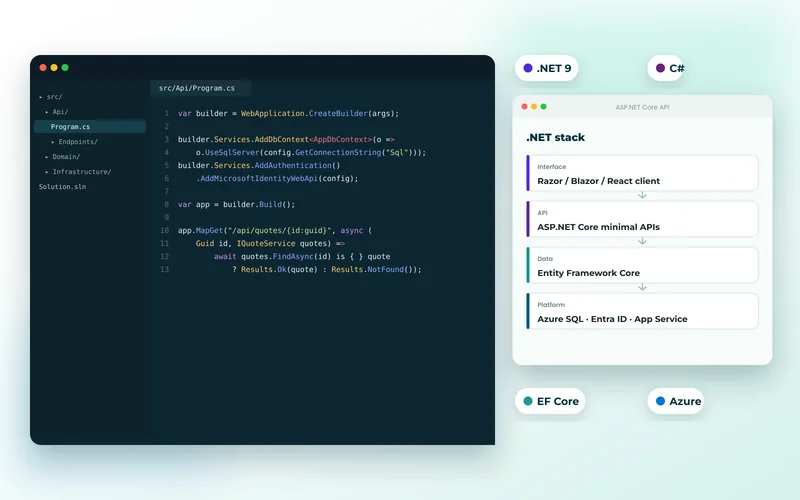
.NET carries an outdated reputation as a closed, Windows-only, enterprise-only platform. Modern .NET is open source, runs natively on Linux, and is among the fastest mainstream web frameworks available. It is a serious option well beyond the organisations that traditionally used it.
What It Is Genuinely Good At
Performance
ASP.NET Core consistently sits at the top of framework benchmarks. More useful than the benchmark, though, is that it performs predictably under sustained load, which matters more for capacity planning than peak throughput figures.
Strong Typing at Scale
C# has a mature, expressive type system, and the compiler catches an entire category of mistakes before anything runs. On a codebase with twenty developers and a ten-year life, that is worth more than the brevity of a dynamic language. It is the same argument that drives TypeScript adoption, applied to the whole stack.
Tooling
Visual Studio and Rider offer refactoring, debugging and profiling that most ecosystems cannot match. On large codebases, confident automated refactoring is a genuine productivity multiplier.
Where It Fits
.NET is the obvious choice when you already run a Microsoft estate — Active Directory, SQL Server, Azure, Dynamics — because the integration points are first-class rather than community-maintained. It is also strong for regulated sectors, where auditability and long-term support matter.
We used .NET development for an insurance claims administration portal, where the domain rules were intricate, several teams worked on the codebase, and the system had to be maintainable for a decade.
Where It Is Overkill
A marketing site, a small business application or an early-stage product usually does not benefit. The ceremony that pays off across twenty developers is friction across two. For those, Laravel or Node.js will get you to a working system sooner and host more cheaply.
Hiring is worth thinking about honestly too: excellent C# developers are widely available, but if your existing team writes JavaScript or PHP, adopting .NET means retraining or recruiting. Our comparison of backend stacks sets these trade-offs side by side.
.NET or Java?
They occupy nearly the same territory, and the decision is usually made by your existing estate rather than by technical merit. Microsoft-centric organisations choose .NET; those running Oracle, Kafka or an established JVM platform choose Java with Spring Boot. Both will still be supported and hireable in fifteen years, which is the actual question being asked.
The Front End
.NET does not dictate your interface. Razor Pages and Blazor keep everything in C#, or you can serve a JSON API and build the front end in React or Angular. Angular is a common pairing on enterprise projects because its structure and strong typing suit the same teams.
Whichever way you go, a public-facing .NET site still needs its content rendered server-side to be crawlable, and still needs the technical SEO basics in place.
Cost
The platform is free and Linux hosting removes the licence costs people still assume. What remains is that .NET applications typically want more memory than a PHP equivalent, and SQL Server licensing is a real expense if you use it — PostgreSQL is fully supported and frequently the better commercial choice. Either way, database design will drive your running costs more than the framework does.
Tell us about your existing systems and team and we will tell you whether .NET is the right fit — or whether something lighter would serve you better.