eCommerce
When a Custom eCommerce Platform Makes Sense, and When Shopify or WooCommerce Is the Better Buy
A custom-built store gives you full control and full ownership, and full responsibility for everything a platform does quietly for its monthly fee. Here is how we decide whether a business genuinely needs its own eCommerce platform, what it really costs after launch, and the questions to settle before anyone writes code.

A few times a year a client asks whether they should stop paying Shopify or wrestling with WooCommerce plugins and build their own store instead. The honest answer, most of the time, is no. A hosted platform gives a small business an enormous amount for its monthly fee, and rebuilding that from scratch is expensive in ways that do not show up in the first quote.
But not always. Our eCommerce development work includes stores on all the major platforms, and our custom web development team builds the cases where none of them fit. This is how we tell the two apart.
What the Platform Fee Actually Buys
Before comparing costs, list what a platform does that a custom build must do itself:
- Hosting that scales during a sale or a mention on television, without you buying servers for the busiest day of the year.
- A secure checkout with the payment integrations, wallets, tax handling and fraud checks already built and maintained.
- Security patches applied for you, every week, forever.
- An admin for products, orders, customers, discounts and refunds that your team can learn from public documentation.
- An ecosystem of apps, themes and developers who already know the system.
A custom store has to provide or replace every one of these. The storefront your customers see is usually the smaller part of the job.
Signs a Custom Build Is Worth It
In our experience a custom platform earns its cost when one or more of these is true:
- Your business model does not fit a cart. Rental with availability calendars, complex configurators, quotes that turn into orders, marketplaces paying out to sellers, or pricing that depends on several variables at once. Platforms can be bent to do these things, but every bend is a workaround someone has to maintain.
- The real work happens in the back office. If staff spend their day in screens the platform never imagined, a custom admin built around their jobs can save more time than the storefront ever earns.
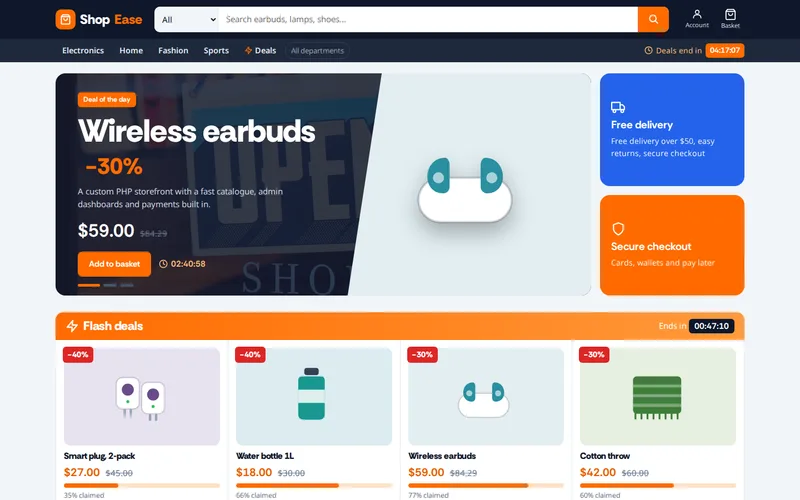
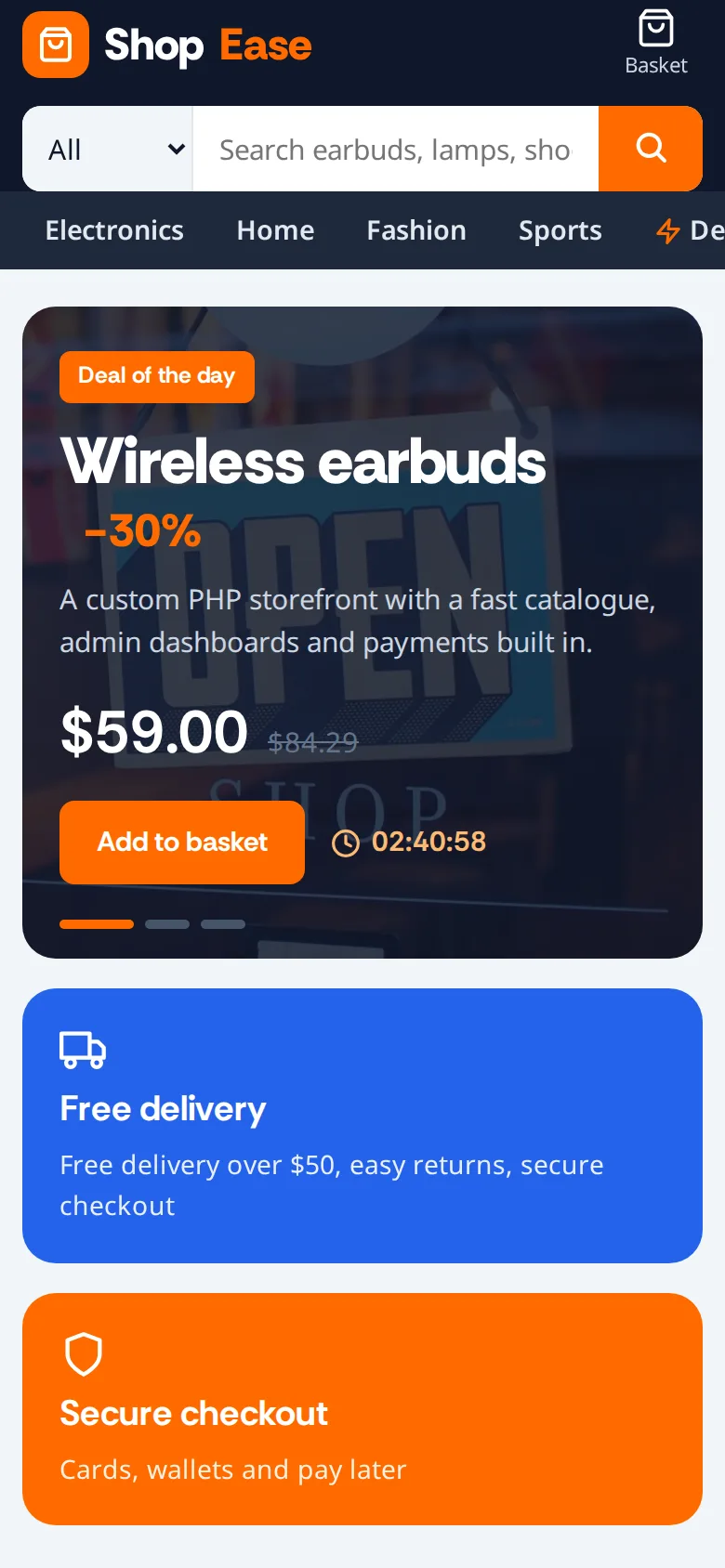
- You are living in a plugin patchwork. The ShopEase platform started here: an online fashion and accessories retailer where every new requirement, a coupon rule, a report, a payment option, had meant another extension, another update to test and another place for things to break during a busy weekend.
- Integrations are the product. When an ERP, a warehouse system or a pricing engine is the source of truth and the store is a window onto it, a platform's own catalogue and stock logic can get in the way.
- Fees grow faster than you do. Transaction fees, paid apps and premium plans add up at high volume. For example, a store paying for a dozen apps plus a percentage on every order may find the yearly total approaches the cost of maintaining its own system. Do the sum with real numbers before deciding.
Signs It Is Not
- Your catalogue, pricing and checkout are broadly standard, even if the design is not.
- You have no budget for ongoing development after launch.
- You need to be trading in weeks rather than months.
- Your team relies on apps for marketing, reviews and email, and wants to keep adding them.
In those cases a well-built theme on a platform, with a small amount of custom code where it matters, is almost always the better buy. Our guide to Shopify apps versus custom development covers that middle ground in more detail.
The Real Costs Come After Launch
A custom store's build cost is visible and negotiable. The running costs are where budgets go wrong:
- Hosting and monitoring, including what happens at three in the morning when something stops.
- Security updates to the language, framework and server, plus periodic testing.
- Payment compliance. Card data should never touch your server. On ShopEase, card details are processed by the payment provider rather than stored by the store, and orders are confirmed only when the gateway confirms payment. That keeps PCI scope small, but the integration still has to be maintained as gateways change their APIs.
- Feature development for ever. Every new payment method, shipping rule or tax change that a platform would roll out for free is now your project.
- Key-person risk. If one developer understands the system, you have a single point of failure.
There are middle routes. A headless storefront keeps the platform for checkout and orders while giving you full control of the front end, which we discuss in when decoupling your storefront pays off. Custom plugins or apps on WooCommerce or Shopify can cover one awkward requirement without replacing everything.
Ownership: Know What You Will Actually Own
One of the strongest arguments for custom is ownership, but it only holds if the contract and handover make it real. Ask your developer:
- Who owns the source code, and where does the repository live?
- Can the system be run by another developer from the documentation alone?
- Is it built on a mainstream language and framework with a long support life?
- Can you export your products, customers and orders in a standard format at any time?
- Who holds the hosting, domain and payment gateway accounts? They should be in your name.
On a platform you own your data but not the software. With a custom build you can own both, provided these answers are written down.
Integrations Often Decide It
The question we ask earliest is not about the storefront at all: which other systems must the store talk to, and which of them is in charge? If stock, prices and customers live in an ERP and the store must follow it in near real time, the integration is the hardest part of either option. On a platform you build it around the platform's data model. On a custom build you design the data model around it. Either way it deserves its own scope, and our API development and integration team usually starts there.
ShopEase took the custom route because the plugin stack had become the problem: the result is one PHP and MySQL codebase with REST APIs between the storefront and the back office, a single admin for products, orders, customers and coupons, and real-time sales analytics. That was the right answer for a team that needed one coherent system. It would have been the wrong answer for a shop with fifty products and a standard checkout.
Questions to Settle Before You Commit
- Which specific requirements does the current platform fail, and what do the workarounds cost each month?
- What is the three-year cost of each option, including hosting, maintenance and development, not just the build?
- Who will maintain the system after launch, and what is the plan if they leave?
- Which integrations are essential on day one, and which system owns each piece of data?
- How will payments be handled so card data never touches your servers?
If you can answer those, the decision usually makes itself. If you cannot, send us the list of things your current store will not do and we will tell you honestly whether they need a new platform or a few weeks of targeted work on the one you have.
Frequently Asked Questions
Is a custom eCommerce platform more expensive than Shopify?
Almost always to build, and often to run, because hosting, security, payment integrations and new features become your responsibility. It can be cheaper over several years for a business with high order volumes, many paid apps or a model that needs constant workarounds on a platform. The only reliable way to know is to compare three-year costs for both options using your real fees and requirements.
Can we start on Shopify or WooCommerce and move to custom later?
Yes, and for many businesses that is the sensible order. A platform lets you prove demand quickly, and by the time a custom build is justified you will know exactly which requirements the platform cannot meet. Keep your product data clean and your integrations documented so that moving later is a migration rather than an archaeology project.
How do custom stores take card payments safely?
The same way platforms do: through a payment gateway using hosted payment fields or a hosted payment page, so card numbers go from the customer's browser straight to the provider and never reach your server. The store receives a token and a confirmation. Built this way, a custom store stays in the lightest PCI compliance category, and orders are only confirmed once the gateway confirms the payment.
What happens if the developer who built our custom store is no longer available?
That depends on decisions made at the start. A store built on a mainstream framework, kept in a repository you own, with written documentation and automated tests, can be picked up by another competent team. One that lives on a single developer's laptop cannot. Make code ownership, repository access and handover documentation part of the contract, not an afterthought.
Is headless commerce the same as a custom platform?
No. A headless store usually keeps a platform such as Shopify or BigCommerce for the catalogue, checkout and orders, and replaces only the front end with a custom one. You get design and performance freedom while the platform still handles payments and security. A fully custom platform replaces the back end as well, which is a much larger commitment.