eCommerce
BigCommerce for B2B: Price Lists, Customer Groups and Quotes
B2B selling needs customer-specific pricing, purchase orders and approval flows. BigCommerce handles more of that natively than most platforms.
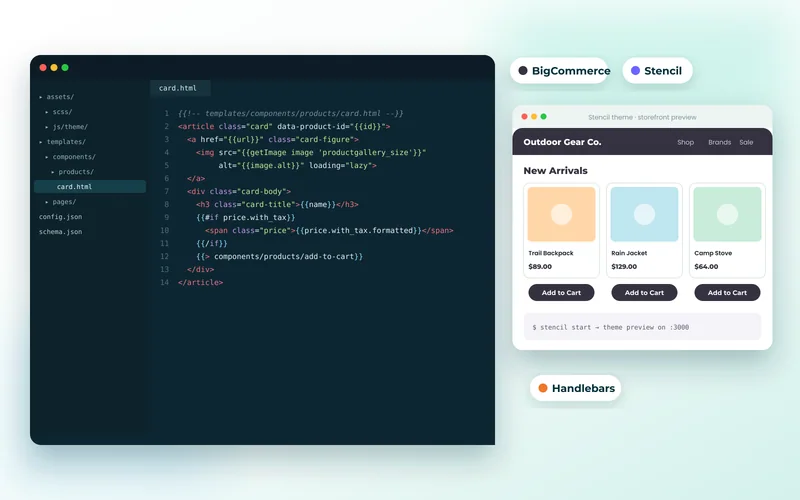
B2B eCommerce is a different problem from retail. Two customers viewing the same product should often see different prices. Buyers need to order against an account rather than a card. Someone may need to approve the order. Quantities come in case packs. Most platforms treat these as extensions; BigCommerce treats several as built-in.
Customer Groups and Price Lists
BigCommerce lets you assign customers to groups and attach price lists to those groups, so pricing is resolved per customer at the catalogue level rather than bolted on at checkout. You can control which categories a group sees, apply percentage or fixed pricing, and set quantity breaks.
Doing the same on other platforms usually means a plugin or app, with the performance and reliability questions that follow. Native handling is a genuine advantage, and it is the main reason we recommend BigCommerce development for trade sellers.
Quotes and Purchase Orders
Many B2B sales begin as a quote. A buyer assembles a basket, requests pricing, a sales representative adjusts it, and the buyer converts it to an order. BigCommerce's B2B tooling supports that flow, along with purchase order payment, company accounts with multiple buyers, and approval hierarchies where junior staff raise orders that a manager authorises.
These are exactly the requirements that cause B2B projects to overrun when the platform does not support them, because each one becomes custom work.
Where Custom Work Is Still Needed
No platform covers everything. Typical remaining work includes contract pricing tied to a customer's ERP record, stock visibility across several warehouses, delivery scheduling, and product configurators where items are made to order.
That work is usually integration rather than storefront development — connecting the store to the systems that hold the real data, through API development and integration. We did this for a medical supplies B2B store and an industrial parts distributor, where the website was the easy part and reconciling it with the back office was the project.
The ERP Question
In B2B, the ERP is usually the system of record for pricing, stock and credit. The store must reflect it without becoming a second source of truth. Decide early what is authoritative for each piece of data and in which direction it flows — this single decision causes more B2B trouble than any other.
We covered a version of this in a wholesaler's ERP and webshop integration. The pattern generalises: one owner per data type, scheduled or event-driven sync, and clear handling for conflicts.
BigCommerce or the Alternatives?
Against Shopify, BigCommerce offers stronger native B2B features and no transaction fees on its own gateway, but a smaller app ecosystem. Against Magento, it is far less work to run — Magento is more capable and considerably more expensive to host and maintain. Against WooCommerce, it is more structured but less flexible.
Our platform comparison in Shopify vs WooCommerce vs BigCommerce goes through this, and scaling WooCommerce is worth reading if you are weighing staying put.
Do Not Neglect the Public Side
B2B stores often have a gated catalogue and a public marketing site. The public side still needs to rank, which means the usual technical SEO work, and the gated side still needs to be fast for buyers placing large orders. Both fall under eCommerce development rather than one or the other.
Tell us how your pricing and approvals work and we will map them to what the platform does natively and what needs building.