Web Development
Custom WordPress Themes vs Page Builders: The Real Trade-Off
Page builders make the first month easy and the next three years harder. A custom theme does the opposite. Here is how to choose deliberately.
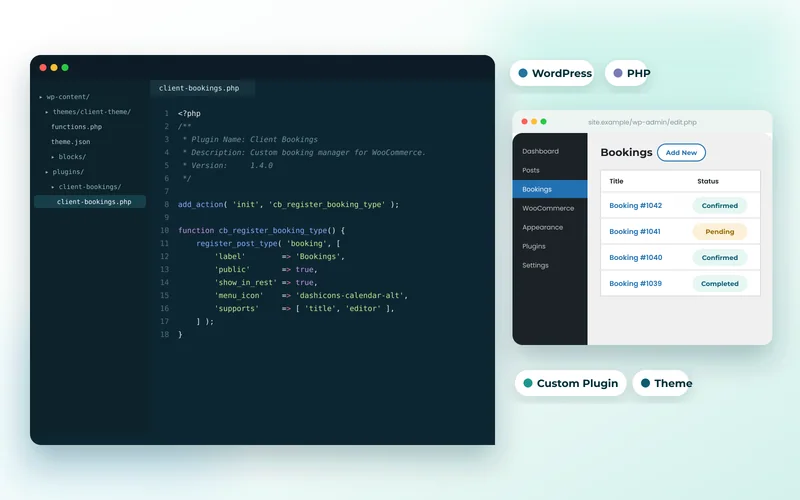
Almost every WordPress project reaches this fork. Page builders such as Elementor, Divi and WPBakery let non-developers assemble pages visually. A custom theme is built for your design and content, with editing constrained to what the design supports. Both are legitimate; the failure is choosing without understanding the consequences.
The Case for Page Builders
Marketing teams can create and change landing pages without waiting for a developer. That is genuinely valuable — a campaign page live this afternoon rather than next week has real commercial worth. Initial build cost is lower, and there is a large supply of people who can work on the result.
For a small business that needs a presentable site quickly and will keep editing it, a builder is often the honest recommendation.
The Costs People Discover Later
- Performance. Builders load substantial CSS and JavaScript on every page, plus deeply nested markup. It is the most common cause of poor Core Web Vitals on WordPress sites.
- Lock-in. Content is stored in builder-specific shortcodes. Deactivate the plugin and pages become unreadable markup. Migrating away is close to a rebuild.
- Design drift. Total editing freedom means every page can diverge. After a year, spacing, type and colours vary page to page.
- Update fragility. Builder, theme and WordPress updates can conflict, and a builder update breaking layouts is a common emergency — one we cover in common WordPress errors.
The Case for a Custom Theme
A custom theme ships only the CSS and JavaScript your design needs, which usually means a faster site without any later optimisation work. Content is stored as ordinary WordPress content, so it remains portable.
Crucially, editing is constrained by design. Editors choose from blocks that were built for the brand, so pages stay consistent no matter who creates them. That is a limitation from one angle and quality control from another.
This is how we approach WordPress development: a custom theme using native blocks, with patterns for the layouts the client actually needs. We built a restaurant group's multisite this way, so each location could manage its own content within one consistent design.
The Middle Ground
The native block editor has improved to the point where it covers most of what businesses used builders for, without the plugin dependency. Block patterns give editors pre-designed sections they can arrange, while the underlying markup stays clean and standard.
For most clients this is now the right answer: a custom theme with a well-chosen set of blocks and patterns. Editors get meaningful freedom; the site keeps its performance and portability.
How to Decide
Choose a builder if you have no development budget for changes, need to publish new page layouts frequently and unpredictably, and performance is not a commercial priority. Choose a custom theme if the site is central to how you win business, if speed matters, or if you expect to keep it for more than a couple of years.
If you are questioning WordPress itself, our comparison of custom websites and WordPress works through that, and headless vs traditional CMS covers the architecture question. Two neighbouring cases come up often: businesses outgrowing a hosted site builder, where website builder development work moves them onto something they own; and content-heavy organisations with complex editorial permissions, where Drupal or Joomla handles structured content and role hierarchies more naturally than WordPress does.
Inheriting a Builder Site
If you already have one and it is slow, there is a lot that can be done short of a rebuild: removing unused plugins, fixing images, deferring scripts and cutting third-party tags. We go through the method in speeding up a WordPress site and deliver it as speed optimisation. Keeping it healthy afterwards is maintenance and support, and website design work can tidy the inconsistency without discarding the content.
Tell us who edits your site and how often — that answer usually settles the decision.