Frameworks & Languages
Django vs FastAPI: Choosing a Python Web Framework
Django gives you a complete application with an admin panel. FastAPI gives you a fast, typed API and nothing else. The right answer depends on what you are building.
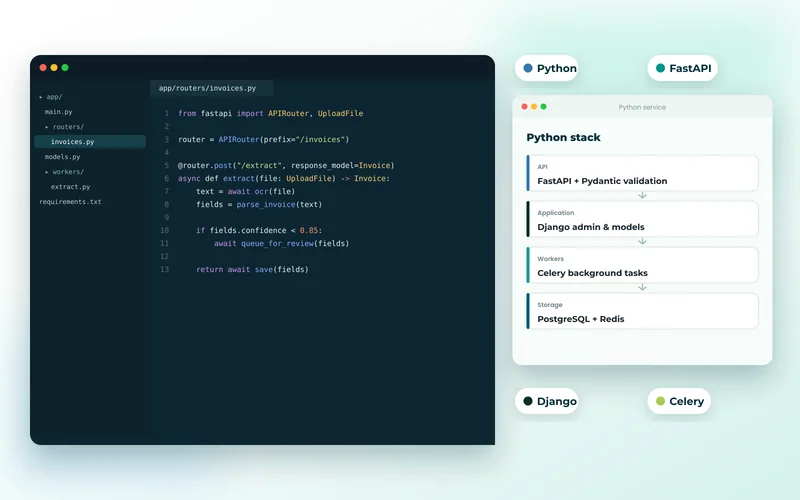
Python's two dominant web frameworks are not really competitors — they solve different problems. Choosing between them is mostly a question of whether you need a complete application or a fast interface to one.
Django: Batteries Included
Django ships with an ORM, migrations, authentication, form handling, templating, security protections and — its stand-out feature — an automatic admin interface generated from your models. For internal tools, that admin alone can save weeks of work.
The trade-off is that Django has opinions. You work its way, with its ORM and its project structure. For most teams that is a benefit: two Django projects look alike, so developers move between them easily.
It suits content platforms, internal systems and data-backed applications where a usable admin is a requirement rather than a nice-to-have. We used Python development on this basis for a university faculty research portal, where staff needed to manage structured records without a bespoke interface being built for every model.
FastAPI: Fast and Typed
FastAPI does one job well: building APIs. It is async-first, validates requests through Python type hints, and generates interactive OpenAPI documentation automatically — which in practice ends arguments between frontend and backend developers about what an endpoint returns.
It is notably quick, both to run and to write. What it does not give you is an ORM, an admin, authentication or templating. You assemble those, typically with SQLAlchemy and a library of your choice.
Choosing Between Them
- Need an admin interface? Django, almost automatically.
- Building a pure API for a React or mobile front end? FastAPI.
- Serving machine learning models? FastAPI — async handling and typed request bodies suit inference endpoints.
- Traditional server-rendered pages? Django.
- Many concurrent I/O-bound requests? FastAPI's async model has the edge.
Using both is perfectly reasonable: Django for the back office, FastAPI for high-throughput endpoints, sharing a database.
Why Python at All?
If the application is ordinary business software, Laravel will usually deliver it faster and host it more cheaply. Python earns its place when the work itself is Python-shaped: data processing, document handling, scientific computation, or anything touching machine learning.
That was the deciding factor in invoice processing with OCR automation — the document pipeline was the product, and the libraries for it exist in Python and nowhere comparable. The same logic applies to most AI integration work, as we set out in practical AI use cases.
Deployment Realities
Python web applications need a WSGI or ASGI server, a process manager and somewhere to run — more involved than dropping PHP files on a host. Dependency management deserves care, because Python environments drift. Containers solve most of this, at the cost of needing DevOps capability on the team.
Async is not a free speed increase either. A synchronous database driver inside an async endpoint blocks the event loop and can make performance worse than the framework you replaced.
A Sensible Default
If you are unsure, start with Django. The admin and built-in features carry a project a long way, and adding FastAPI endpoints later is straightforward. Starting with FastAPI and discovering you needed an admin means building one.
Whichever you choose, the database design will affect performance more than the framework, and a clean API contract matters more than either.
Tell us what the system needs to do and we will recommend the framework — and say plainly if Python is not the right language for it.