Frameworks & Languages
Is Ruby on Rails Still a Good Choice?
Rails is no longer the loudest framework, but it is still among the fastest ways to turn an idea into a working product. Here is where it stands.
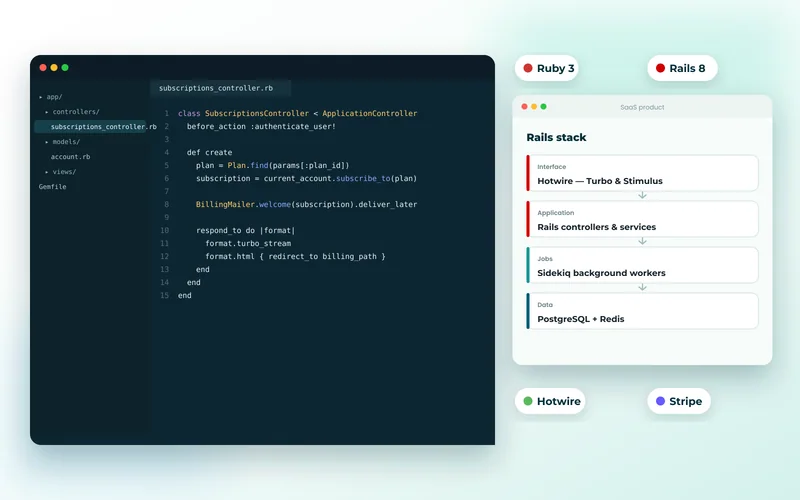
Rails stopped being the default choice for new startups some years ago, and a lot of people concluded it was finished. It is not. It is mature, actively developed, and still one of the quickest routes from a clear idea to a working, maintainable product.
What Rails Does Well
Convention over configuration remains its defining idea: follow the expected structure and a great deal simply works without being wired up. Combined with generators, a mature ORM and an excellent testing culture, a small team can build a substantial application remarkably quickly.
The ecosystem is deep and stable. Authentication, background jobs, file uploads, payments, admin interfaces — the well-trodden gems have been maintained for years, which means fewer surprises than younger ecosystems where a key library may be abandoned.
Ruby on Rails development suits SaaS products, marketplaces and internal platforms where iteration speed matters more than squeezing out microseconds.
Hotwire Changed the Calculation
The strongest recent argument for Rails is Hotwire — Turbo and Stimulus — which delivers a responsive, app-like interface by sending HTML over the wire rather than building a separate JavaScript application.
For a large class of products this removes an entire layer. No separate front-end codebase, no API to design purely for your own UI, no duplicated validation. One team, one codebase. Compared with running Rails plus a React front end, it is dramatically less work, and it sidesteps the crawlability problems we describe in choosing a front-end framework.
The Honest Downsides
- Hiring. The pool is smaller than for JavaScript or PHP. Rails developers tend to be experienced, which is good, but there are fewer of them and they cost more.
- Raw performance. Ruby is slower than Go, Java or C#. For typical database-bound web applications this rarely decides anything, but at extreme scale it does.
- Hosting. More involved than PHP, less so than it used to be.
- Convention as constraint. Applications that do not fit Rails' assumptions can end up fighting it.
Rails or Laravel?
They are closer than their communities admit — Laravel borrowed heavily and deliberately from Rails. In practice the decision is about people and hosting: Laravel has a larger hiring pool and cheaper, more universal hosting, while Rails has slightly more polish in places and a stronger testing tradition.
For most clients we recommend Laravel for exactly those commercial reasons. Where a team already knows Ruby, that advantage disappears and Rails is the better choice. Our backend stack comparison covers the wider field.
Inheriting a Rails Application
A common situation: a business depends on a Rails application built years ago, and the original developers are long gone. Rewriting is usually the wrong instinct. A well-structured Rails app can be upgraded incrementally — Ruby version, Rails version, dependencies — and modernised without discarding years of encoded business rules.
We handle that through maintenance and support and, where things are actually broken, troubleshooting and bug fixes. The usual first win is the database, as covered in why sites slow down as they grow.
Running a Rails application and unsure whether to invest or move? Tell us what you have and we will give you a straight assessment rather than an automatic recommendation to rebuild.